

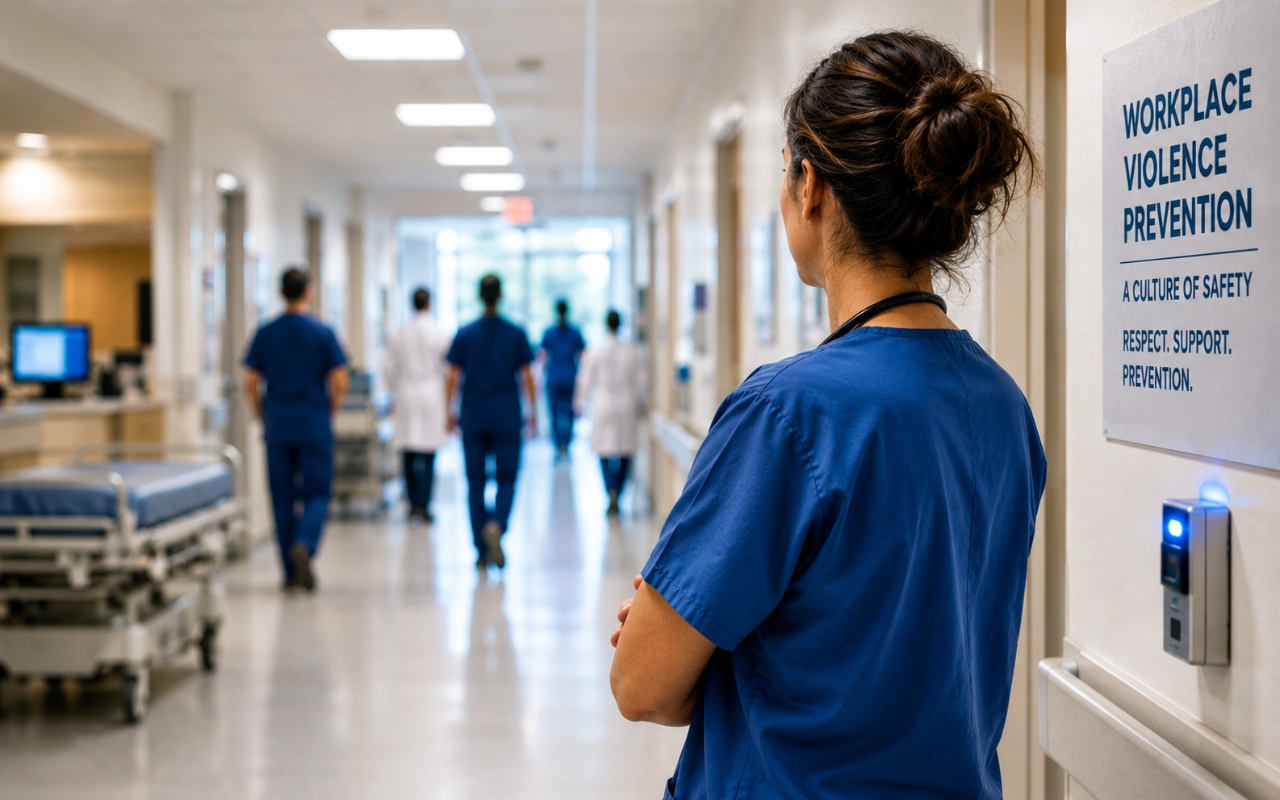

Most hospitals still focus on security to prevent workplace violence, but Memorial Hermann Health System now takes a broader approach. Leaders say addressing workplace violence requires changes not only in security but also across clinical, operational, and cultural areas.
That philosophy is now driving a systemwide three-year strategy led in part by John Voigt, Vice President and Chief Nursing Officer at Memorial Hermann The Woodlands Medical Center and co-chair of the system’s Workplace Violence Prevention Committee.
Building on this philosophy, Memorial Hermann last year convened more than 60 healthcare professionals from across the system to examine workplace violence from the frontline perspective. The effort identified 285 unique challenges and produced 21 evidence-based solutions that now anchor a three-year roadmap built around 10 strategic initiatives.
Workplace violence prevention at Memorial Hermann broadened from a primarily security-focused approach to a clinical and operational strategy. Leaders identified 285 challenges and created 21 evidence-based solutions. The resulting three-year plan features standardized screening, behavioral health integration, AI-enhanced reporting, de-escalation training, and initiatives designed to better protect all hospital stakeholders.
Moving Beyond “WPV 1.0”
Voigt said Memorial Hermann had already expanded security efforts in response to rising aggression and violence following the COVID-19 pandemic.
“We were seeing more frequent incidents of agitation and aggression from both patients and visitors, and the system responded with what I call WPV 1.0: increasing security officer presence, installing weapons detection systems, building out simulation training, standing up a dedicated training center, and deploying other strategies aimed at mitigating violence and aggression,” Voigt said. “That foundation was critical, and it made a real difference.”
However, this foundation was only the beginning. In July 2025, the organization deliberately shifted its approach.
“Instead of asking only ‘how do we stop violence when it happens,’ we brought together 60 clinical leaders from across the system and asked a different question: ‘How do we provide better care to the patients who are at the highest risk of becoming violent or aggressive?’” he said.
Voigt described reframing as the turning point.
“That reframing—from a security-first to a clinical and operational approach—moved us from WPV 1.0 to 2.0 and reshaped how we approach this challenge.”
The Hidden Complexity of Workplace Violence
One of the most significant findings from the summit, Voigt said, was the sheer complexity behind workplace violence incidents.
“When people think about workplace violence in healthcare, they tend to think about the psychiatric patient in the ED,” he said. “And that’s real, but it’s only one piece of it.”
Clinical leaders identified a much broader range of contributors, including cognitively impaired geriatric patients, neurodivergent patients whose care needs are not fully understood, distressed family members, and emotionally charged family dynamics during critical illness.
“It’s the geriatric, cognitively impaired patient who becomes aggressive at night,” Voigt said. “Or the neurodivergent patient whose needs aren’t being met by a one-size-fits-all care approach. It’s scared family members who are acting out of fear and helplessness.”
The exercise reinforced why narrowly focused solutions often fail.
“When you see the full range of challenges, it’s clear why narrow solutions fail. Addressing workplace violence requires input from all clinical areas, not just the ED or behavioral health.”
What Nurses Say They Need
Voigt said nurses consistently communicate three priorities when discussing workplace safety.
The first is trust that leadership is genuinely committed to protecting staff.
“Nurses tell us they want to know the organization truly cares and is intent on keeping them safe,” he said.
He said frontline clinicians quickly recognize whether safety initiatives are authentic or simply compliance-driven.
“Nurses can tell when safety programs are authentic versus just compliance,” he said.
Second, nurses want better clinical preparation and practical tools to safely manage escalating situations.
“That means we need to change how we educate them on de-escalation techniques, how to approach and treat different psychiatric diagnoses, what medications to use for different patient populations, and how to establish a standard of care that keeps both the clinical team and the patient safe,” Voigt said.
He believes this remains one of healthcare’s largest blind spots.
“This clinical dimension is where most health systems still have significant gaps,” he said.
The third concern centers on accountability outside hospital walls.
“Nurses see other professions with legal protections against assault and wonder why the same doesn’t exist for them,” Voigt said.
Technology, Prevention, and Visibility
Memorial Hermann has deployed several high-profile interventions, including weapons detection systems, K-9 units, and body-worn cameras.
According to Voigt, the system’s concealed weapons detection technology screened more than 1.9 million people across five campuses in fiscal year 2024, identifying 466 guns, nearly 3,000 knives, and 395 additional weapons.
“That’s measurable prevention,” he said. “People don’t bring weapons into the hospital without knowing about them. That technology takes a real threat off the table before it ever reaches a nurse.”
Voigt said K-9 units have also proven effective in de-escalating tense situations before physical intervention becomes necessary.
“There’s a well-documented de-escalation effect when a trained K-9 is present,” he said.
He is especially interested in the emerging role of body-worn cameras in healthcare environments.
“The evidence from law enforcement is clear that cameras reduce use-of-force incidents and improve behavior on both sides of an encounter,” Voigt said. “We’re working to bring that same accountability and transparency to healthcare settings.”
Tackling Underreporting and Normalization
Voigt said workplace violence reporting remains one of healthcare’s biggest cultural challenges.
“We’ve held system-wide town halls, campus-level town halls, and communicated directly with all of our leaders that we want to know anytime a clinician feels they are in an unsafe situation,” he said.
Memorial Hermann also developed the SHARP framework to establish standardized language for reporting behavioral concerns. The acronym stands for Shouting, Hostile behavior, Aggressive gestures, Repeated threats, and Physical contact.
“A shared vocabulary changes that,” Voigt said. “And when staff see that their reports lead to real changes, like better staffing, environmental modifications, or new protocols, it breaks the cycle of ‘why bother reporting, nothing will happen.’ The key takeaway is that visible results from reporting encourage staff to speak up and foster a proactive safety culture.”
Still, he believes normalization remains one of the profession’s deepest problems.
“Nurses have been told for generations that getting hit is part of the job,” he said. “It’s not.”
Voigt said sustained leadership visibility is essential to changing that mindset.
“You have to say it out loud, repeatedly, and then back it up with action,” he said.
Building a Three-Year Roadmap
The system’s structured roadmap emerged directly from frontline collaboration.
Voigt said the 60-member summit group identified service-specific risks and categorized proposed solutions by effort and impact.
The strategy includes policy standardization, AI-enhanced reporting, universal screening, expanded duress notification, and crisis response integrations.
“Stop trying to design your WPV program in a boardroom,” Voigt said. “Go to your frontline staff, give them a structured process, and listen. They already know the problems. They usually know the solutions, too.”
The Gaps That Remain
Despite progress, Voigt said behavioral health capacity remains one of the largest unresolved challenges facing healthcare systems nationwide.
“We have patients in our emergency departments with acute psychiatric needs who are boarding for days because there’s nowhere appropriate to send them,” he said. “While they’re boarding, staff are managing their behavioral crises with limited specialized support. That’s a safety issue for everyone.”
He also acknowledged the challenge of creating consistent workplace violence prevention standards across large, varied healthcare systems.
“What works at a Level II trauma center may need to be adapted for a community hospital or an ambulatory surgery center,” he said.
A Broader Accountability Problem
Voigt believes healthcare organizations still underestimate the scope of the issue when workplace violence is viewed only through a security lens.
“If I’m being candid, most health systems are still treating workplace violence as a security problem when it’s actually a clinical, operational, and cultural problem,” he said.
“But if you don’t have standardized screening, multidisciplinary response teams, robust reporting systems, and a culture where nurses feel empowered to speak up, your security infrastructure is just a facade.”
He argued that leadership accountability must become more visible and measurable.
“Every CNO, CMO, and CEO in the country should be able to tell you exactly how many workplace violence incidents occurred in their system last quarter, what the trends are, and what they’re doing about it,” Voigt said. “If they can’t, that tells you everything about their priorities.”
He also called for stronger legal protections for healthcare workers nationwide.
“Healthcare workers deserve the same workplace violence protections as airline crews, law enforcement officers, and transit workers,” he said. “The fact that assaulting a nurse often carries the same consequences as a simple assault is a policy failure that needs to be addressed at the state and federal levels.”
