
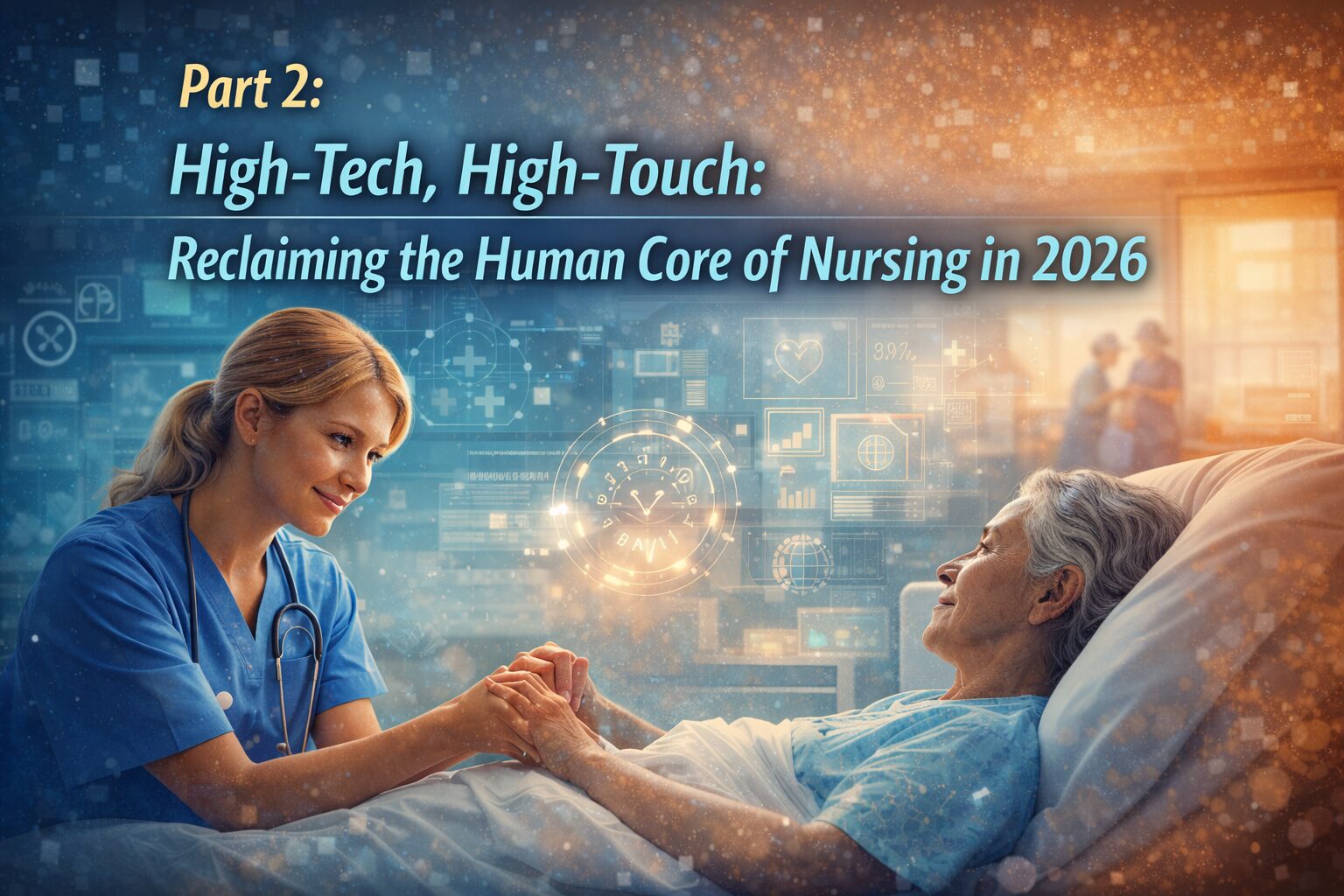
Technology may finally be easing nurses’ workloads in 2026, but that progress has sharpened a more urgent question. What parts of nursing should never be automated? As systems become more intelligent and interconnected, nurses are drawing clearer boundaries around what technology should support and what must remain human. Presence, listening, touch, judgment, and relationship-building are no longer seen as “soft skills,” but as the core of nursing practice that technology exists to protect, not replace.
What Does High-Tech, High-Touch Nursing Mean in 2026?
High-tech, high-touch nursing in 2026 means using AI and automation to reduce administrative burden while intentionally preserving human connection. Success is defined by how well technology supports presence, listening, clinical judgment, and patient relationships rather than replacing them.
Jeanne Venella, senior clinical advisor at Canopy Works, describes today’s reality plainly. “Nurses still care deeply, but the system leaves little time or capacity for connection, forcing them into task-driven survival mode instead of true bedside practice.”
She says the heart of nursing hasn’t disappeared; it has been crowded out. Looking toward 2026, she sees a shift toward redesigning workflows and using technology to support, rather than replace, human connection.
Venella warns that if presence, listening, touch, and noticing are not actively preserved, burnout and moral distress will continue to grow. The normalization of AI-enabled workflows at scale, she says, will be the most consequential event shaping nursing—and nurses must be involved at every stage.
Where Nurses Are Taking Human-Centered Care Outside the Hospital
Many nurses are also redefining where that human-centered care takes place.
Taylor Stanley, RN, leadership nurse on the executive team of Salt. Hydration & Wellness, predicts continued movement away from hospital systems as nurses build independent businesses across wellness, coaching, nutrition, and functional health.
She notes that flexibility, autonomy, and the ability to create community-level change are powerful draws, particularly for younger nurses. Drawing on her own experience, she says that once people move from being “patients” to “clients,” deeper, more empowering change becomes possible.
Why Advanced Practice and Specialization Will Define 2026
Specialization is another defining theme for 2026. Anneli Kumpula, NP, co-founder of Elevate Hospice, predicts a convergence of workforce shortages, AI integration, and demand for advanced expertise. She describes AI as a “co-pilot” that will handle documentation and predictive monitoring, allowing nurses to focus on emotional support, teaching, and complex care. She also highlights rapid growth in home health, geriatrics, chronic care, and psychiatric nursing—areas where focused expertise will drive autonomy and career resilience.
Jung Baccam, FNP-BC, of Atlas Ketamine, reinforces that advanced practice roles will expand as provider shortages persist. She predicts nurses with strong digital fluency and comfort with telehealth, analytics, and AI tools will become key drivers of patient-centered innovation—particularly in holistic care, mental health, and health equity.
Erica Marrero, APRN-BC, of Bariendo, emphasizes that 2026 will be shaped by responses to chronic workforce fatigue, not just burnout. She notes growing interest in palliative care, hospice, outpatient clinics, and hybrid clinical-education roles, with nurses prioritizing sustainability, values alignment, and leadership earlier in their careers.
Takeaway: In 2026, reclaiming the human core of nursing won’t mean rejecting technology—it will mean using it deliberately to protect presence, purpose, and patient connection.
➡️ Read Part 3: Career Adaptability, Leadership, and Nursing’s Next Chapter
