


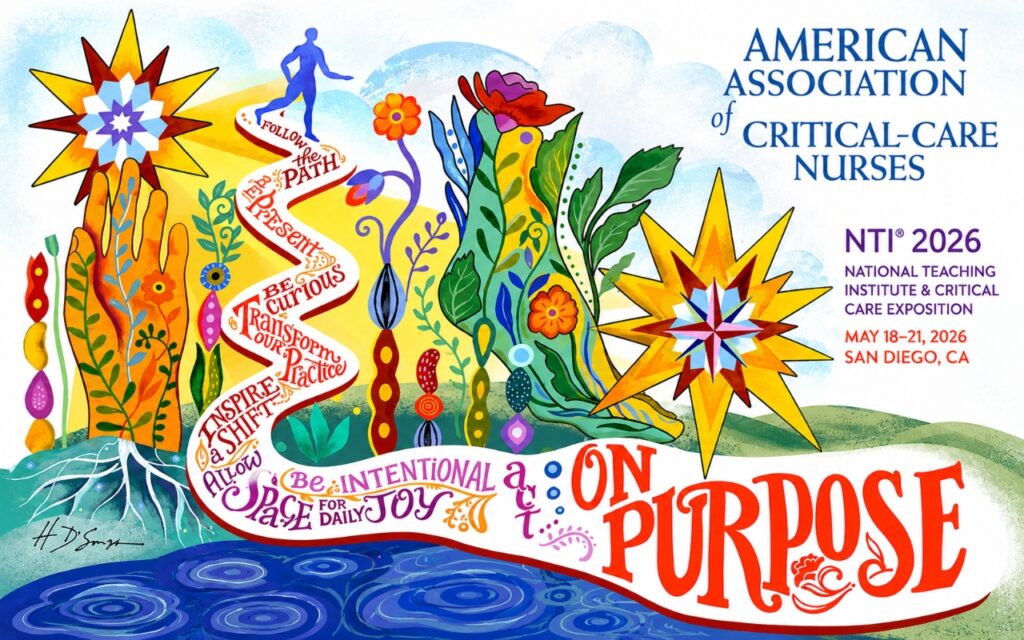
During Monday’s keynote at the AACN National Teaching Institute & Critical Care Exposition (NTI) 2026 in San Diego, AACN President Rebekah Marsh said healthcare’s future depends on frontline leadership and collective action, built on collaboration, psychological safety, diplomacy, and healthy work environments.
Addressing thousands of critical care nurses, Marsh highlighted the need to rethink approaches to division, workplace culture, and professional well-being in healthcare. He stressed that diplomacy, collaboration, psychological safety, and purposeful action are all vital for achieving lasting change, reinforcing the importance of cohesion across healthcare systems.

“Good intentions are not enough, and effective action will require collaboration,” Marsh said. “If organizational mission and personal intention are on opposite ends of the spectrum, then shared purpose is our relational sweet spot.”
A Call for Consensus in a Polarized Healthcare Environment
Amid ongoing staffing shortages, burnout, and workplace challenges, Marsh encouraged nurses to approach disagreement with curiosity.
“While the world has been described as increasingly polarized, and maybe it feels that way sometimes on social media, this hasn’t been my experience,” she said.
Marsh described polarity as a continuum rather than a battle between opposing sides.
“For our most polarizing issues, there are sides,” she said. “Most likely, there are many perspectives along a complete spectrum, and there is a unifying path forward if we care enough about each other to find consensus.”
She connected that philosophy directly to clinical practice, particularly in environments where nurses may hesitate to raise concerns.
Marsh cited an AACN study where only 32% of clinicians reported speaking up during crucial moments.
“It can make us hesitate to speak up when there is a lack of psychological safety on the team,” she said.
The findings highlight ongoing concerns about communication, team dynamics, and clinician safety inside healthcare workplaces.
AACN’s Healthy Work Environment Efforts Gain Momentum
A key announcement highlighted AACN’s long-standing efforts to create healthy work environments.
Marsh revisited the origins of AACN’s “Standards for Establishing and Sustaining Healthy Work Environments,” first published in 2005 and revised in 2016 in response to concerns about staffing shortages, workplace conflict, and nurse retention.
The standards focus on:
- Skilled Communication
- True Collaboration
- Effective Decision-Making
- Appropriate Staffing
- Meaningful Recognition
- Authentic Leadership
Marsh said these efforts are developing into an evidence base that is influencing healthcare policy and practice.
“What was once just an idea is beginning to coalesce into the mountain of evidence required to support systemic change,” she said.
She also highlighted a milestone many nurse leaders have pushed for over the past two decades.
AACN’s partnerships led The Joint Commission to identify staffing as a National Performance Goal, marking its first prominent regulatory inclusion.
The development signals growing recognition of staffing conditions as a patient-safety and workforce-sustainability issue.

Frontline Nurses Leading Change From Within
Marsh stressed that meaningful healthcare transformation is often gradual, driven by sustained frontline engagement.
She pointed to AACN’s Clinical Scene Investigator (CSI) Academy as one example of that strategy in practice.
“In collaboration with funding partners such as Johnson & Johnson, AACN has launched 80 AACN Clinical Scene Investigator teams in 2025, another 80 in 2026, and 80 more are planned for next year,” Marsh said.
The program empowers bedside nurses to lead unit-based improvement initiatives within their own organizations.
“The power of CSI is the power of the frontline,” Marsh said. “It’s having project leaders embedded in the culture.”
Marsh, the first former CSI nurse to become AACN president, described the initiative as proof that small actions can create long-term ripple effects across the profession.
Addressing Burnout Without “Toxic Positivity”
Marsh also spoke candidly about the emotional toll nurses continue to carry years after the COVID-19 pandemic.
Drawing from her own experience as one of Harborview Medical Center’s early COVID operations nurses, she recalled the emotional strain of teaching nurses to reuse masks during supply shortages.
“Despite my training and dedication, teaching nurses to reuse their masks wasn’t something I was fully prepared for,” she said.
Rather than framing resilience as constant optimism, Marsh emphasized the importance of finding “glimmers of joy” amid difficult working conditions.
“Our moments of public recognition are often too few and far between to be our only source of resilience,” she said.
She described moments of support from colleagues, walks with her dog after shifts, and small routines during the pandemic as critical sources of grounding.
“It isn’t about toxic positivity or about being blind to the problems we face,” Marsh said. “Because of what I have learned about the power of incremental change, I cannot help but believe that every contribution matters.”
Nursing’s Trust Is Built Through Human Connection
Marsh closed Monday’s keynote by reflecting on nursing’s longstanding public trust, noting that nurses have ranked as the most trusted profession in Gallup polling for 24 consecutive years.
“What I find so fantastically powerful is that this trust is built one relationship at a time,” she said.
She also emphasized the importance of diverse perspectives in shaping the profession, referencing nurses working in Ukraine and colleagues navigating complex cultural identities within healthcare.
“Inclusion of diverse perspectives is key to a holistic understanding of what it means to be a professional nurse, and what it means to be human and to belong,” Marsh said.
Marsh concluded by urging intentional action rooted in humanity, collaboration, and purpose.
“Imagine what we will do together when we Act On Purpose.”
