

There is a pervasive tension in emergency nursing. It’s not solely driven by patient acuity or volume; it’s driven by timing. More specifically, it’s a result of the delay between recognizing what a patient needs and being able to begin that care.
Why Emergency Department Delays Are Built Into the System
In many emergency departments, that delay is built into the system’s structure. A patient is triaged, an initial assessment is performed, and a plan begins to take shape. However, in many emergency departments, meaningful care often does not start until a treatment space becomes available. This creates a gap between clinical judgment and clinical action. Over the course of a shift, that gap repeats itself across dozens of patients.
The traditional sequence of triage, waiting, bed placement, and then initiation of care has become standard practice. While this model appears uniform and orderly, it focuses on later stages of the visit and underutilizes earlier ones. Patients with clear clinical needs may experience delays before diagnostic tests or treatments are initiated. Nurses are left managing both the clinical implications of delay and the emotional impact on patients and families who perceive that little is happening.
How Delays Contribute to Nurse Burnout and Job Strain
This structure contributes to a strain distinct from workload alone. Nurses frequently identify what needs to be done but are unable to act within the expected timeframe. That disconnect can lead to frustration, reduced sense of efficacy, and gradual erosion of professional satisfaction. While burnout in emergency nursing is often attributed to volume and acuity, system-imposed delays are increasingly recognized as a contributing factor.
A Nurse-Led Approach to Emergency Department Flow Redesign
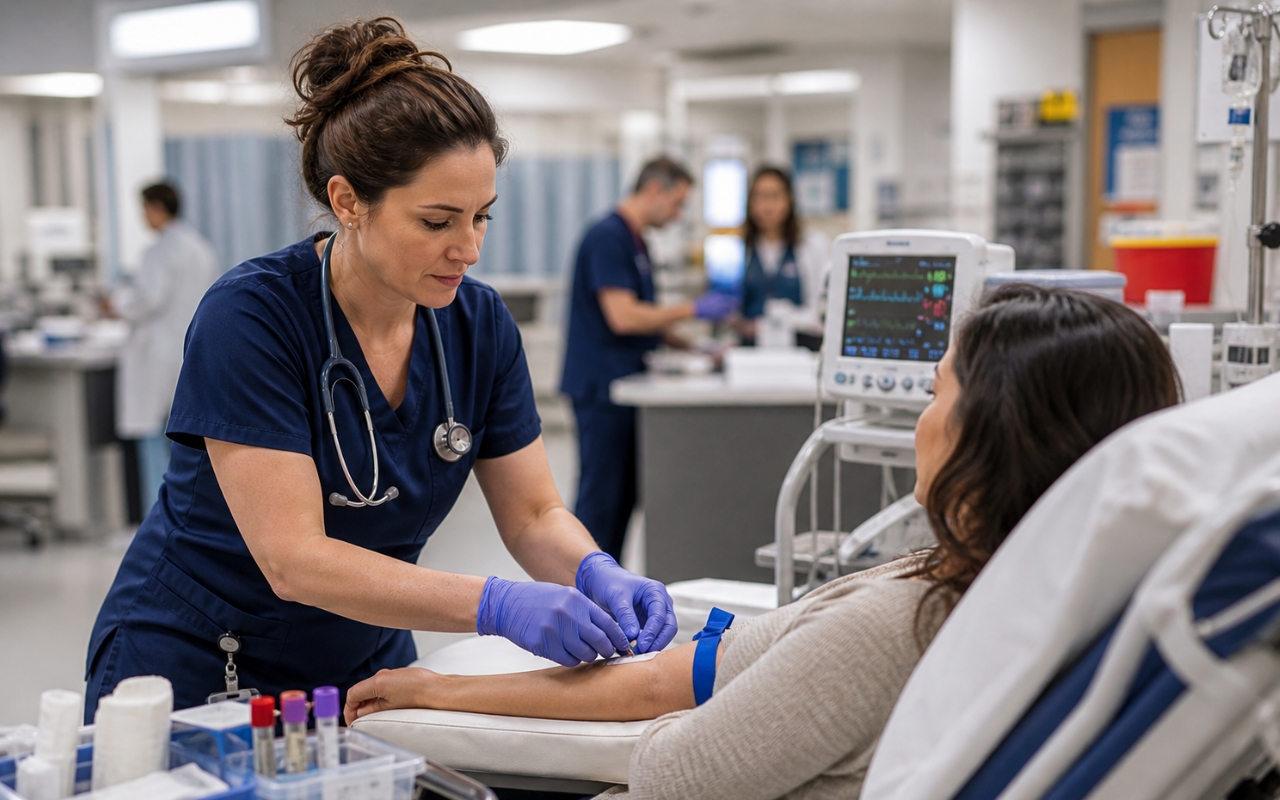
A nurse-led redesign of emergency department flow offers an alternative approach. In this model, care is intentionally decoupled from bed availability. Diagnostic tests and initial treatments are initiated immediately after triage rather than deferred until placement in a treatment room. The provider conducts a full evaluation of the patient within the first hour of arrival, after which blood samples, electrocardiograms, imaging requests, and first-dose medications are completed at the front end of the visit. Instead of waiting for an available bed to initiate care, the patient receives their care in the front end of the department. Oftentimes, these patients can wait in the waiting room for results rather than occupying a formal bed, shifting the traditional ED flow.
This shift in timing can produce operational benefits, but its impact on nursing practice is equally important. When care begins earlier, the nurse’s role becomes more continuous and aligned with clinical reasoning. Assessment leads directly to action. Instead of identifying needs and deferring them, nurses can initiate care in real time.
Supporting Proactive Nursing and Clinical Decision-Making
Nurses working within this model often describe their practice as more proactive and more professionally rewarding. Acting early reduces the accumulation of unresolved tasks and supports a clearer sense of progress throughout the shift. Clinical judgment is reinforced rather than constrained by system limitations.
Patient experience is also affected by this change. Although waiting cannot be eliminated, it can be made more structured and purposeful. Patients who have had diagnostic tests initiated or symptoms addressed often perceive that care has begun. This reduces uncertainty and contributes to fewer expressions of dissatisfaction related to inactivity. Communication shifts from explaining delays to outlining next steps.
Creating a More Efficient and Predictable ED Workflow
At the department level, the redistribution of work creates a more stable operational rhythm. Instead of care beginning in concentrated bursts when treatment spaces become available, activity is distributed across the patient journey. Results may become available earlier in the patient visit, allowing for more timely decision-making. Departments that use this approach often experience a smoother, more predictable workflow, with fewer abrupt surges and improved coordination between disciplines.
In many cases, this approach can be implemented without increasing staffing or expansion of physical space. The same clinical tasks are performed, but earlier. By reducing idle time and aligning actions with clinical insight, the system becomes more efficient without increasing overall workload.
Why This Model Matters for Nurse Retention
This approach may have meaningful implications for nurse retention. Professional satisfaction is often tied to the ability to provide timely and effective care. When nurses consistently act on their assessments and see the impact of their interventions, the work feels meaningful and sustainable. When care is repeatedly delayed due to structural constraints, that sense of purpose diminishes over time.
Rethinking Emergency Department Care Delivery
Emergency nursing will always involve complexity and high demand. However, not all sources of strain are inherent to the environment. Some are the result of design choices that can be reconsidered. Decoupling care from bed availability represents one such shift. By allowing care to begin at the point of recognition rather than at placement, emergency departments can better support both patient outcomes and the nurses who deliver that care.
