


Estimated reading time: 9 minutes
When Grace Grau, DNP, APRN, ACNP-BC, AACC, FAAN, entered nursing in the mid-1980s, she does not remember seeing Hispanic nurses teaching her classes or holding leadership positions at the South Florida hospitals where she completed her clinical rotations.
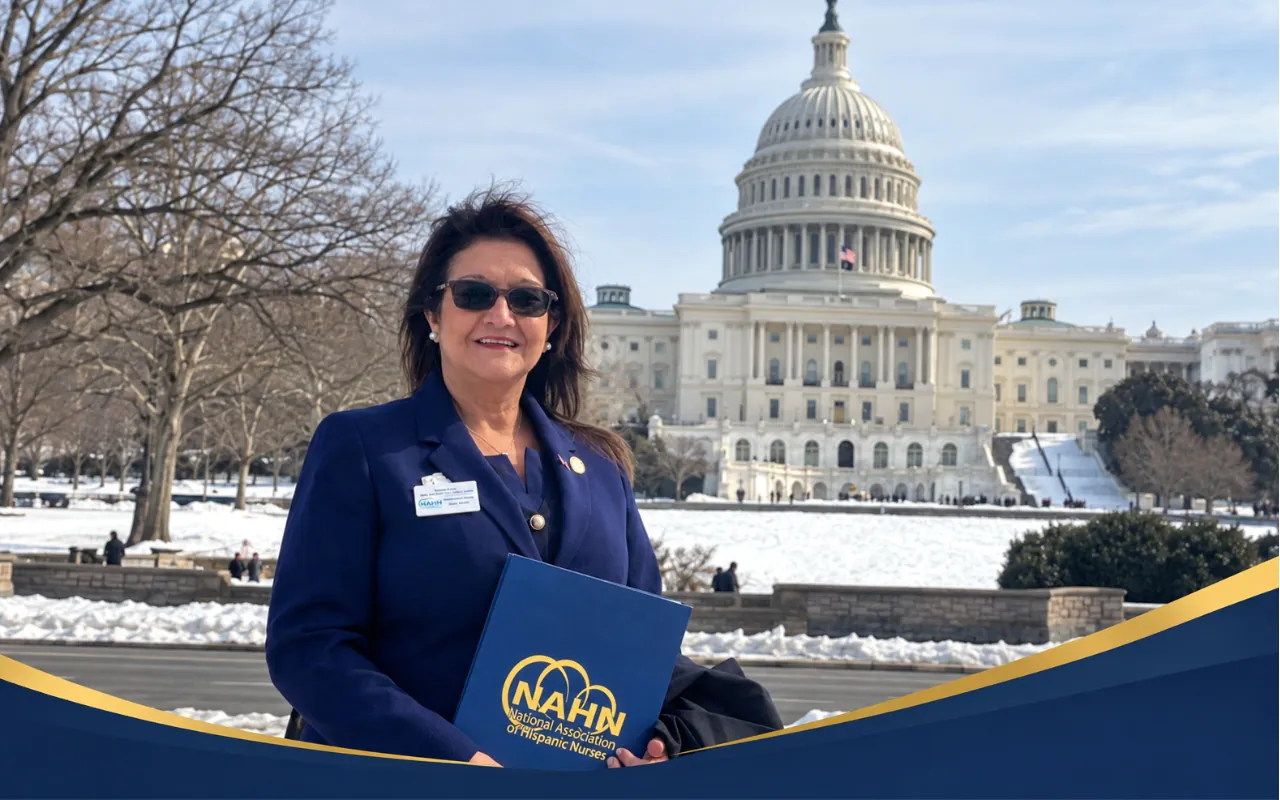
Today, Grau is president of the National Association of Hispanic Nurses (NAHN), and she wants to ensure that Hispanic nurses’ contributions are recognized and documented for the nurses who come next.
“For too long, much of our impact has gone undocumented and, as a result, underrecognized,” Grau said. “If we do not measure our contributions, preserve our history, and tell our own stories, others cannot fully understand the influence Hispanic nurses have had, and continue to have on nursing, healthcare, policy, education, research, and communities.”
As Nurse Approved recognizes National Hispanic Heritage Month, Grau’s path to national nursing leadership shows both how opportunities for Hispanic nurses have expanded and the barriers she believes still make it harder for some to enter and advance in the profession.
Her own path was anything but direct.
“We Need Good Nurses”
Grau once planned to become an English teacher.
That changed in 10th grade when a teacher suggested she consider math or science because so many students wanted to teach English. Grau chose science, which interested her and connected with the work her mother was doing as a nurse’s aide.
But the moment that ultimately led her to nursing came when she accompanied her mother to work one evening.
As her mother made rounds, they encountered a frail, elderly patient lying in soiled linens with dried excrement on her skin.
“My mother whispered under her breath, ‘We need good nurses,’ and it was then I decided to become a nurse,” Grau said.
At the time, Grau’s image of nursing was largely confined to hospitals and nursing homes. As she progressed through her clinical rotations, she encountered patients whose lives broadened her understanding of the profession.
During her first semester, she encountered patients whose stories of overcoming obstacles and survival stayed with her, including Holocaust survivors.
“Their stories of overcoming obstacles and survival were a great inspiration, and to some extent I’m sure, informed how I would face challenges in my own life,” Grau said.
Her nursing program also emphasized continuing education. Faculty encouraged students to go beyond a nursing diploma, introducing possibilities that included earning a BSN and pursuing graduate education.
Grau decided she would become a nurse practitioner.
Getting there would take years.
A Puerto Rican Family, Public Housing and a Duty to Return
Grau was the fourth of six children and the eldest daughter in a working-class Puerto Rican family. She spent her first nine years in public housing in New York City, where her family sometimes relied on food assistance and charitable support.
As a child, she said, she did not think of her family as poor.
After the family moved to Miami, she began recognizing socioeconomic differences and the stigma that could accompany them. She also became aware that her family received healthcare through a free clinic. Those early experiences would later influence how she understood healthcare access and inequity.
Her father, who had experienced discrimination and language barriers as a young Puerto Rican in New York, made sure his children knew their heritage. Spanish was required at home. He taught them Puerto Rican history, sewed Puerto Rican flags onto their jackets, and took them to the annual Puerto Rican Day Parade.
Education was equally important.
“The value of pursuing an education is not just in what you learn, but in what you do with that knowledge, and in remembering that you have a duty to come back and serve the community you came from,” Grau recalled her father telling her.
That idea has remained central to how she views leadership.
“My heritage gave me my identity. My family gave me my values. My upbringing gave me my purpose,” Grau said.
Seeing the Possibilities in Nursing
Although Grau does not recall Hispanic nursing faculty or many Hispanic nurses in leadership during her early education, she did encounter them after she began working as an emergency medical technician in the emergency department at Hialeah Hospital in 1981.
Many of the nurses were Hispanic, she said, including charge nurses and nurse managers. A Cuban nurse served as nursing director, providing Grau with an early example of Hispanic nursing leadership.
Still, she credits a much broader group with helping her understand what was possible.
Her nursing director, Martha Garcia, met with her every day for a week to teach her how to interpret EKG rhythms so she could pass ACLS. A respiratory therapist taught her to interpret arterial blood gases and oxygen delivery modalities. Nurses taught her assessment, documentation, and clinical skills. Physicians taught her to interpret 12-lead EKGs and X-rays and helped develop her advanced assessment skills.
“It was the entire village from my diploma program to my colleagues in the ED, from 1981-1986 that really helped me see the possibilities,” Grau said.
That experience later informed her belief that getting nurses into the profession is only one part of improving representation. Nurses also need people willing to help them move forward.
When Advancement Became Harder
After moving from South Florida to Alabama, Grau became more aware of what it could mean to be a Hispanic nurse seeking advancement.
During one job interview, she said an interviewer looked her up and down and told her, “Well, you’re certainly not from the South.”
Grau declined the opportunity.
Other experiences were less overt. She recalled offering suggestions during meetings that went unacknowledged until non-Hispanic colleagues repeated them. She also saw leadership opportunities go to others despite her seniority and experience.
“At the time, I did not fully recognize the cumulative impact of these experiences,” Grau said. “Looking back, I realize that these barriers not only delayed my professional advancement but also had long-term financial consequences.”
The experiences strengthened her commitment to equitable opportunities, representation, and leadership development for Hispanic nurses, she said.
Grau’s path to nursing had already required considerable persistence.
She married at 16 and became a single mother by 20 following domestic abuse. She completed nursing prerequisites and earned her EMT certification, but later struggled with reading comprehension and test-taking in nursing school.
After failing pediatric theory twice, she was told, “Perhaps nursing is not for you.”
She applied to another nursing program and was accepted.
“These experiences taught me that setbacks do not define our potential,” Grau said. “I often share this story to offer hope to students who may be struggling themselves.”
She ultimately progressed from a nursing diploma to bachelor’s, master’s, and doctoral education.
Why the Nursing Pipeline Still Matters
Grau believes many of the barriers affecting Hispanic and Latino representation in nursing begin well before nursing school.
First-generation college students may have limited exposure to nursing careers, few professional role models, and no one in their families who has navigated college admissions, financial aid, or the demands of nursing education, she said.
“When you are the first, you are often learning the system as you go,” Grau said.
Language can add another challenge. Although Grau was born and raised in the United States, Spanish was her first language, and she said she struggled with language proficiency early in her education.
But she cautions against treating language proficiency as a measure of potential.
“We have to be very careful not to equate an accent or English-language proficiency with intelligence, ability, or potential,” Grau said. “We need educational environments that provide students with the support they need to strengthen their language and communication skills while also recognizing bilingualism and biculturalism as tremendous assets to our profession and the communities we serve.”
Cost presents another obstacle, she said. Beyond tuition, nursing students may have to pay for books, fees, uniforms, transportation, and clinical requirements while potentially losing income because the demands of nursing school make working difficult.
Getting Into Nursing Is Only Part of the Challenge
Earning an RN license does not automatically create a path to leadership.
“Advancing into leadership requires more than being good at your job,” Grau said. “It often requires mentorship, sponsorship, professional networks, leadership development, and someone who recognizes your potential and opens a door.”
That is why Grau argues that nursing needs to address the entire pipeline, from introducing young people to the profession and helping students graduate and become licensed to creating pathways into leadership.
NAHN chapters are already working on parts of that pipeline through career programs, scholarships, mentorship, professional development, and opportunities for nurses to lead and serve, she said.
“Ultimately, it is not enough to simply increase the number of Hispanic nurses entering the profession,” Grau said. “We want them to have the support and opportunities to succeed, remain in nursing, advance into leadership, and help shape the future of our profession and the health of the communities we serve.”
What She Wants to Do With the Presidency
For Grau, becoming NAHN president carries significance beyond the title.
“It represents the sacrifices my parents made to rise above our humble beginnings and to instill in me a deep appreciation for education, service, and a commitment to something greater than myself,” she said.
It also represents the mentors and colleagues who invested in her along the way and the trust of the nurses who selected her to lead the organization.
Grau has identified two priorities for her presidency.
The first is the long-term sustainability of NAHN at a time when she says professional nursing organizations face challenges around membership and engagement. She wants nurses to better understand the role professional organizations can play in advocacy, professional opportunities, and strengthening nurses’ collective voice.
Her second priority is to document and elevate the contributions Hispanic nurses have made across nursing, healthcare, policy, education, research, and their communities.
For Grau, the two goals are connected.
“Sustainability is not only about preserving an organization; it is about ensuring that the legacy, influence, and contributions of Hispanic nurses are recognized, valued, and carried forward,” she said. “We must document where we have been, demonstrate the impact we are making today, and build an organization capable of carrying that work into the next 50 years.”
It is a destination the young Grau never envisioned.
“The young version of me was courageous, an optimist and dreamer,” she said. “She didn’t see challenges as obstacles.”
But Grau said that younger version of herself never imagined becoming president of anything.
What would surprise her most is not the title.
It is how far her work has reached.
“While the young Grace didn’t have a clue of what potential meant, and never imagined being president of anything, I think she would be inspired.”
