

Estimated reading time: 4 minutes
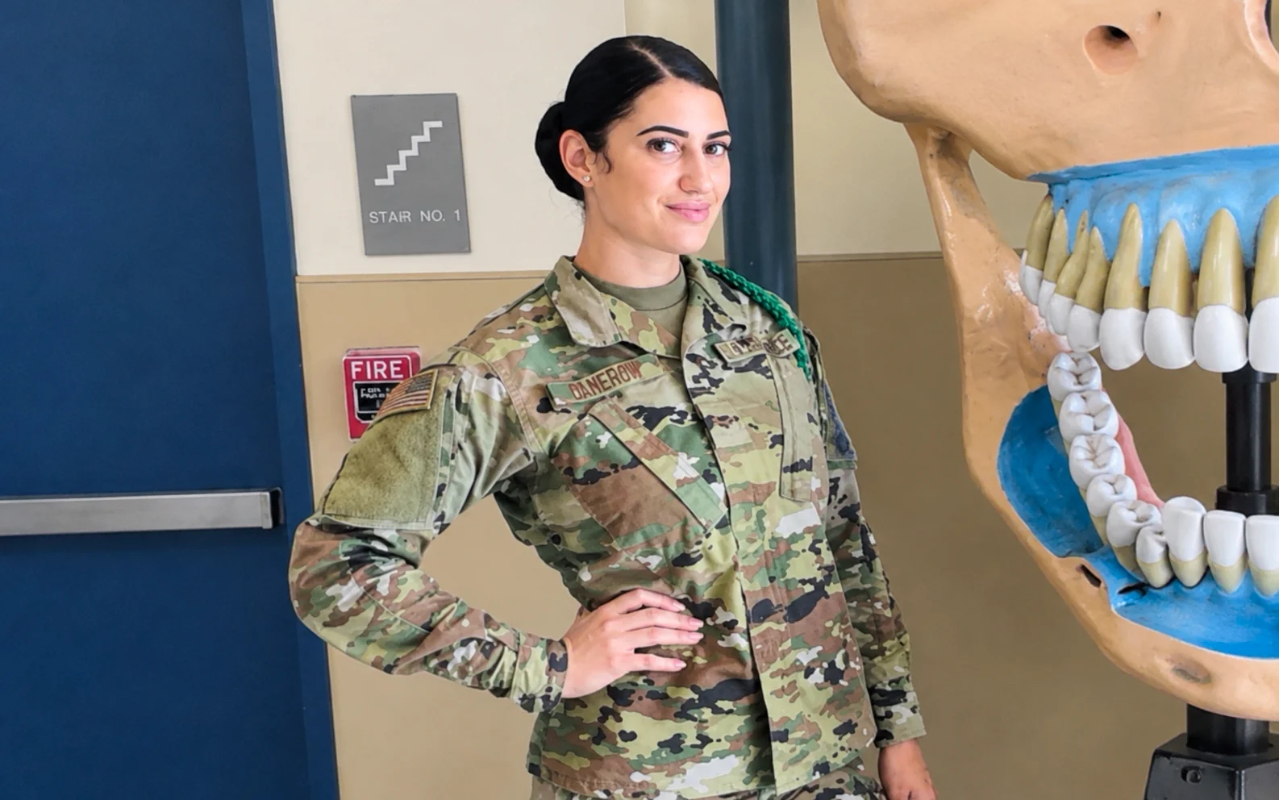
For Staff Sgt. Melissa Damerow, military service has always been about answering a call to help others. Now, the 33-year-old Air Force reservist is pursuing a nursing career to care for service members when they need it most.
Want to see more Nurse Approved articles in your Google results? Add us as a preferred source.
Add Nurse Approved as apreferred source on Google
Damerow, of San Luis Obispo, California, comes from a family with deep military ties. Her maternal grandfather and father both served, and her son’s father is also a military veteran.
“I felt like it was meant to be,” Damerow said. “I don’t know why it took me so long in life to figure that out. It’s something that’s going to be a part of me for the rest of my life. It’s a call to serve.”
As the nation observes Veterans Day on November 11, Damerow’s journey highlights a different path to military nursing, one that began not at the bedside but as a dental assistant in the Air Force Reserve.
“It’s a higher calling,” Damerow said. “I want to be able to provide that care for someone when they need it most.”
Military Nursing and the Workforce Shortage
Damerow began her military career as a reservist in 2019, a year before the COVID-19 pandemic placed unprecedented demands on the nursing workforce.
According to the National Council of State Boards of Nursing, approximately 100,000 registered nurses left the workforce because of stress and burnout during the pandemic.
The nursing workforce continues to face challenges. The Health Resources and Services Administration projects a national shortage of 267,330 full-time equivalent registered nurses by 2028, with that shortage expected to decline to 108,960 by 2038.
Workforce shortages also affect military nursing. A study published in the American Journal of Nursing in January 2026 reported that approximately 16,000 military nurses serve in the Army, Navy, and Air Force Nurse Corps across active-duty, National Guard, and Reserve components.
The study, “Exploring Retention Among Army Nurses: A Qualitative Study,” also identified a shortage of more than 1,300 active-duty military nurses. Researchers found that leadership, mentorship, and the challenges of balancing nursing and military responsibilities influence nurses’ decisions to remain in service.
For Damerow, who currently serves as a unit training manager with 100 direct reports, pursuing nursing represents an opportunity to expand her ability to care for fellow service members.
Finding Her Path to Nursing
Damerow’s interest in healthcare began before she joined the Air Force Reserve.
After earning a bachelor’s degree in kinesiology from California State University, Northridge, in 2016, she worked at a gym, in a physical therapy office, and as a personal trainer.
Her background in rehabilitation remains an area of interest as she considers her future nursing career.
“I like the rehab part as well, when it comes to healthcare,” she said. “Potentially, one day I could work with the VA as another way to try to give back.”
When Damerow joined the Air Force Reserve, the medical positions available to her at March Air Reserve Base in Riverside, California, were limited. Nursing positions were primarily officer roles, while other healthcare positions involved administrative responsibilities.
Seeking a more hands-on role in patient care, she chose to become a dental assistant. But she eventually realized she wanted to do more.
While on maternity leave in 2021, Damerow began reconsidering her career path.
In 2022, she joined Nightingale College as an administrative assistant in nursing education. That same year, she moved to Lackland, Texas, where she worked as a dental assistant alongside active-duty nurses at Joint Base San Antonio-Lackland.
The experience provided additional opportunities to complete hospital rotations.
During her time at Lackland, Damerow received Level 2 CPR training and combat medic training.
“It drew me in,” Damerow said. “It’s the rush of being able to provide care for someone in such a high-demand and intense situation and the idea of really being in a position to help save someone’s life.”
Encouraged by her supervisor and colleagues, Damerow began pursuing her nursing degree at Nightingale College in 2023.
Answering the Call to Serve
Damerow expects to graduate in August 2027 and hopes to transition from the Air Force Reserve to active-duty service as a military nurse.
Her goal is to complete at least one six-year contract, combining her nursing education with the military commitment that has shaped much of her adult life.
Although her path to nursing has been unconventional, Damerow sees it as a natural extension of her desire to serve.
“The military asks us to remember what our ‘why’ is and never to lose track of it,” Damerow said. “For me, it’s being there for someone.”
