

Estimated reading time: 6 minutes
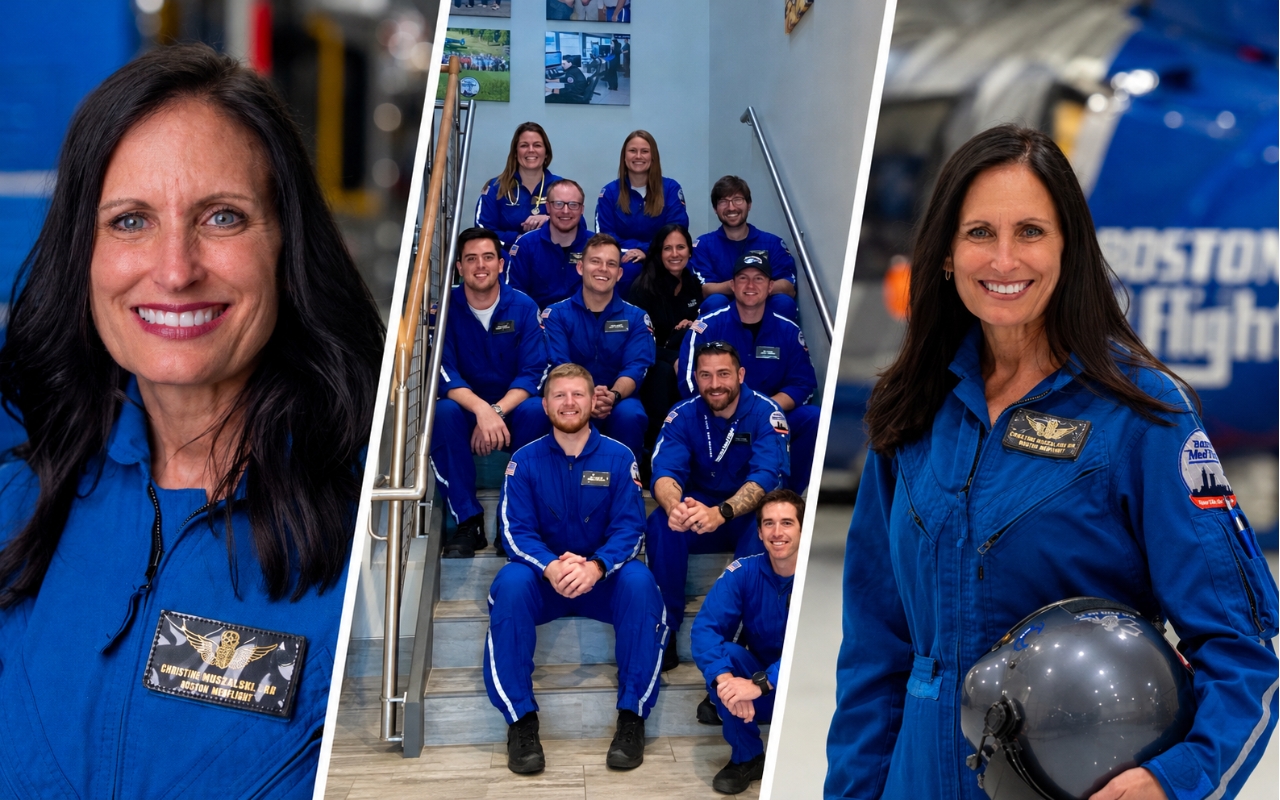
When Christine Muszalski, MSN-Ed, RN, EMT-B, CFRN, CEN, CCRN, CNPT, thinks about one of the patients who has stayed with her, she remembers a woman she cared for shortly after Boston MedFlight began carrying blood products.
The woman had sustained devastating traumatic injuries. During transport, Muszalski and her team provided transfusion therapy before reaching the trauma center.
Their time caring for her was brief. Their connection was not.
Muszalski later visited the woman during her recovery and stayed in touch with her and her husband. She eventually invited them to Boston MedFlight’s annual Patient Reunion.
They have returned every year since as volunteers.
“We may only care for a patient for a brief moment, but the impact of those moments can last a lifetime,” Muszalski said. “Every patient is someone’s loved one, and every transport is an opportunity to change the course of someone’s life.”
For Muszalski, a critical care transport nurse and Clinical Orientation Manager at Boston MedFlight in Bedford, Massachusetts, those brief encounters have been part of nearly three decades in flight nursing.
She has spent 35 years in critical care nursing, 30 years in emergency nursing and 28 years as a flight nurse. Twenty-five years ago, she also created Boston MedFlight’s annual Patient Reunion so crews could see something critical care transport clinicians do not always get to witness: the rest of the patient’s story.
Now, much of her work is also focused on preparing other clinicians to care for the patients who will come next.
Her work earned her recognition as the Board of Certification for Emergency Nursing’s 2026 Distinguished CFRN.
As Emergency Nurses Week is recognized Oct. 11–17, Muszalski’s career offers a look beyond the dramatic image of flight nursing to what the specialty actually requires: bringing ICU-level care to critically ill patients during transport while making clinical decisions in challenging environments.
Want to see more Nurse Approved articles in your Google results? Add us as a preferred source.
Add Nurse Approved as apreferred source on Google
The Helicopter Is Only Part of Flight Nursing
Muszalski readily acknowledges one of the profession’s attractions.
“I have to admit, I really do love to fly,” she said. “There is nothing quite like lifting off knowing you are on your way to help someone who desperately needs you.”
But the aircraft does not define the job.
“The helicopter is simply our vehicle,” Muszalski said. “What defines our specialty is preparation, teamwork, communication, and bringing ICU-level care to patients wherever they are. Flight nursing is less about adrenaline and more about disciplined clinical decision-making in challenging environments.”
That responsibility is what has kept her engaged after nearly three decades in flight nursing.
“Every time the tones go off, I know someone is depending on us during one of the most vulnerable moments of their life,” Muszalski said. “It is an incredible privilege, and I have never lost sight of that.”
Her motivation, she said, can be distilled into one thought:
“I get to help somebody today.”
Seeing the Rest of the Patient’s Story
Critical care transport can create an unusual relationship between nurse and patient. The clinical stakes may be high, but the time together can be short.
The annual Patient Reunion gives Boston MedFlight crews an opportunity to reconnect with former patients and their families.
“Every year, former patients and their families return to Boston MedFlight headquarters to reconnect with the clinicians who cared for them during one of the most difficult days of their lives,” Muszalski said. “Those reunions remind us that while we may only be part of someone’s journey for a few hours, those hours can have a lifelong impact.”
The woman Muszalski cared for after Boston MedFlight began carrying blood products became one of those returning patients. She and her husband now come back as volunteers.
“Seeing survivors and their families return year after year is an incredible gift for our crews,” Muszalski said.
Preparing Clinicians to Trust Their Judgment
As Clinical Orientation Manager, Muszalski helps prepare clinicians for the demands of critical care transport.
For her, one of the greatest rewards is watching a new clinician develop confidence.
“New clinicians often arrive feeling overwhelmed, but through mentorship, simulation, and experience, I have the privilege of watching them grow into confident, thoughtful professionals,” Muszalski said. “One of the most rewarding moments is when they no longer need my answers because they have learned to trust their own judgment.”
That emphasis on developing clinicians also shapes how she views the future of critical care transport.
Muszalski points to continued advancement in simulation, structured orientation, mentorship, and competency-based education.
“Investing in clinicians ultimately improves outcomes for every patient we care for, and I believe the future of our specialty is as much about developing people as it is about advancing technology,” she said.
What Makes an Exceptional Flight Nurse
Beyond technical expertise, Muszalski values humility, kindness, integrity, curiosity, and communication in her teammates.
“Technical expertise saves lives, but trust, respect, and teamwork are what make exceptional patient care possible,” she said.
For flight nurses specifically, Muszalski points to compassion, resilience, emotional intelligence, curiosity, and the ability to remain calm under pressure.
“Patients may not remember every intervention we perform, but they will remember how we made them feel,” she said.
A Career Built Around Investing in People
Muszalski’s work has also extended into the Boston community.
She created an annual holiday helicopter event in which Santa and his helpers arrive by helicopter on Boston Common while toys are collected for Christmas in the City.
What began as an idea 25 years ago became a tradition that brings together children, families, first responders, and the community.
“It reminds me that emergency nurses do not just respond to emergencies,” Muszalski said. “We also educate, inspire, and build lasting connections with the communities we serve.”
That same emphasis on people runs through her work with patients, clinicians and nursing students.
“Knowing the clinicians I have mentored will go on to care for thousands of patients is one of the most meaningful legacies I could hope for,” she said.
When Muszalski considers what she hopes people remember about her career, she returns to the relationships behind the clinical work.
“I hope people remember that I genuinely cared,” she said. “My patients remember they were never alone. I hope my colleagues remember someone who treated others with kindness and respect, and the clinicians I have mentored remember that I believed in them before they believed in themselves.”
After 35 years in critical care nursing, Muszalski’s motivation has remained remarkably consistent.
“I still begin many shifts with one simple thought. ‘I get to help somebody today,’” Muszalski said. “After 35 years in critical care nursing, 30 years in emergency nursing, and 28 years as a flight nurse, that is still exactly how I feel.”
