
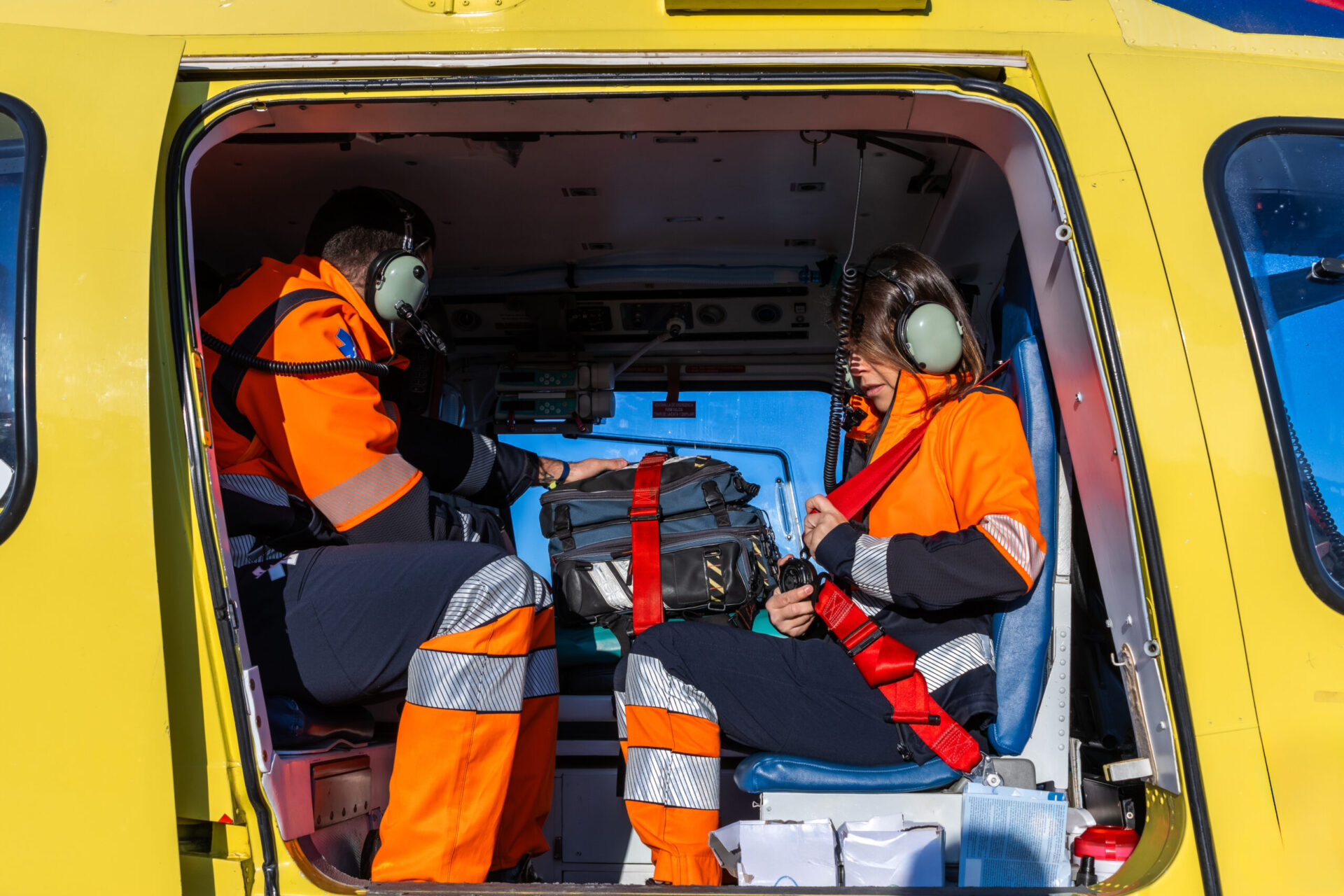

When Katy Wilson begins her shift, there is no checklist that guarantees what the day will hold. As a flight nurse with more than 20 years of critical care experience, her “unit” may be a helicopter cabin, a fixed-wing aircraft, or a remote landing zone miles away from the nearest hospital. Every shift carries uncertainty—and the responsibility to deliver ICU-level care in the most unpredictable environments imaginable.
Flight nursing is not an entry-level role. It is a specialty built on years of bedside experience, advanced training, and the ability to make high-stakes decisions quickly and independently.
What Does a Flight Nurse Do?
Flight nurses provide advanced medical care to critically ill or injured patients during air medical transport. Their role bridges emergency medicine, trauma care, and critical care nursing, often in environments where resources are limited and conditions are constantly changing.
Katy’s responsibilities range from stabilizing patients at rural hospitals to managing complex ventilators, vasoactive infusions, and invasive monitoring mid-flight. “You don’t have a full team behind you,” she explains. “You are the team.”
The Clinical Background Required to Become a Flight Nurse
Katy’s path to flight nursing began long before she ever stepped into an aircraft. She spent two decades working in high-acuity settings, primarily intensive care units and emergency departments. This experience was foundational.
Flight nurses must be comfortable managing rapid deterioration, interpreting subtle changes in patient status, and intervening without hesitation. “There’s no time to second-guess yourself,” Katy says. “Your critical thinking has to be automatic.”
Education, Training, and Certifications for Flight Nursing
Becoming a flight nurse requires more than experience alone. In addition to a nursing degree, flight nurses maintain multiple advanced certifications such as ACLS, PALS, and trauma credentials. Many pursue specialty certifications like the Certified Flight Registered Nurse (CFRN) designation.
Training is ongoing and multifaceted. Aviation safety, survival training, emergency simulations, and recurrent skills assessments are standard. Clinical knowledge must stay current, and proficiency must be maintained under conditions that are far from controlled.
A Typical Shift for a Flight Nurse
Shifts often range from 12 to 24 hours, much of it spent on standby—until the call comes. When it does, everything changes in seconds.
One shift might involve transporting a patient with a severe traumatic brain injury from a rural emergency department to a Level I trauma center. Another may require managing a cardiac patient on multiple infusions while navigating turbulence and limited cabin space. “Once the call comes in, it’s full focus,” Katy says. “There’s no easing into it.”
Delivering Critical Care at 3,000 Feet
Providing care in the air presents unique challenges. Noise, vibration, lighting limitations, and restricted movement complicate even basic procedures. Equipment must be secured, communication must be concise, and decisions must be precise.
“You learn to rely on preparation and muscle memory,” Katy explains. “Everything you do has to be intentional.”
Teamwork and Communication in Air Medical Transport
Flight nurses never work in isolation, but they do work with lean teams. Katy typically flies with a paramedic or another flight clinician, forming a partnership built on trust and clear communication. Each team member understands their role but remains adaptable.
“There’s no room for ego,” she says. “Your partner’s safety and the patient’s outcome depend on how well you work together.”
The Physical and Emotional Demands of Flight Nursing
The workload extends beyond physical demands. Flight nurses often encounter patients and families in moments of crisis—after catastrophic injuries, strokes, or sudden medical emergencies.
Katy recalls a pediatric transport where rapid intervention stabilized a critically ill child long enough to reach definitive care. “Those moments stay with you,” she says. “You feel the weight of every decision.”
Is Flight Nursing the Right Path for You?
For nurses considering this specialty, Katy emphasizes honesty and preparation. Flight nursing is not about adrenaline or prestige—it’s about accountability, resilience, and mastery of your craft.
“It’s one of the most challenging roles in nursing,” she reflects, “but also one of the most meaningful. You don’t just care for patients—you carry responsibility at altitude.”
Inside the shift of a flight nurse is a world where expertise meets courage, and where experience is not optional—it’s essential.
