


Estimated reading time: 7 minutes
What happened if someone became sick on July 4, 1776?
Someone cared for them.
This Fourth of July, as Americans celebrate the nation’s 250th anniversary, fireworks will fill the sky, flags will fly, and people across the country will commemorate the adoption of the Declaration of Independence. But amid the celebration, one question often goes unasked: who cared for the sick and wounded as the nation was born?
There were no registered nurses, no nursing schools, no antibiotics, and no anesthesia. Hospitals were few, and medical knowledge was limited. Yet illness and injury did not stop simply because a nation was being born.
During the fight for independence, thousands of men and women quietly cared for wounded soldiers, comforted the sick, prepared medicines, cleaned hospital wards, and helped patients survive disease in one of the most uncertain periods in American history.
Who Cared for Patients in 1776?
To answer that question, it helps to look at how healthcare worked in colonial America.
Healthcare in colonial America looked very different from today’s system.
Most people never entered a hospital. Care was usually provided at home, where family members—particularly women—looked after sick relatives. Midwives cared for mothers and newborns; neighbors often stepped in during times of illness; and physicians traveled from house to house to treat patients.
When war broke out in 1775, however, the Continental Army faced a new challenge: caring for thousands of soldiers suffering from wounds, infectious diseases, and the hardships of military life.
Recognizing that an army could not fight without caring for its sick and wounded, General George Washington urged the Continental Congress to establish a formal hospital system. On July 27, 1775, Congress approved hospitals for the Continental Army and directed that one nurse be assigned for every 10 hospitalized soldiers. According to the Journals of the Continental Congress, nurses initially earned $2 per month, while a supervising matron oversaw every 100 patients.
More than 250 years before today’s debates over nurse staffing, the Continental Congress had already recognized that patients required adequate nursing care. By authorizing one nurse for every 10 hospitalized soldiers, lawmakers made clear that caregiving was essential to recovery and to the health of the Continental Army.
Recruiting nurses, however, proved difficult. According to the University of Pennsylvania School of Nursing’s Nursing Through Time project, Washington believed compensation was too low to attract enough caregivers. Congress raised nurses’ pay from $4 per month in 1776 to $8 per month in 1777, reflecting the growing demand for caregivers and the importance of nursing to the army’s success.
Hospitals Were Uncommon and Often Feared
Outside of a handful of cities, institutional healthcare barely existed in colonial America. Most people were born, cared for, and often died at home.
One notable exception was Pennsylvania Hospital in Philadelphia. Founded in 1751 by Benjamin Franklin and Dr. Thomas Bond, it became the nation’s first chartered hospital and helped shape early American medicine.
Military hospitals were established throughout the colonies to care for sick and wounded soldiers, but they bore little resemblance to today’s medical centers. Supplies were scarce. Buildings were overcrowded. Bedding and clean clothing were limited, and caregivers worked under demanding conditions with little understanding of how infectious diseases spread.
For many patients, these makeshift hospitals offered both hope and hardship. They provided lifesaving care, yet disease could spread quickly through crowded wards.
The First Military Nurses Wore No Scrubs
The word “nurse” meant something very different in 1776.
Military nurses were not licensed professionals because no such profession yet existed. Instead, they were ordinary people who accepted extraordinarily difficult work under extraordinary circumstances.
Many were women hired to care for soldiers, although historical records show that some men also served as nurses in Continental Army hospitals.
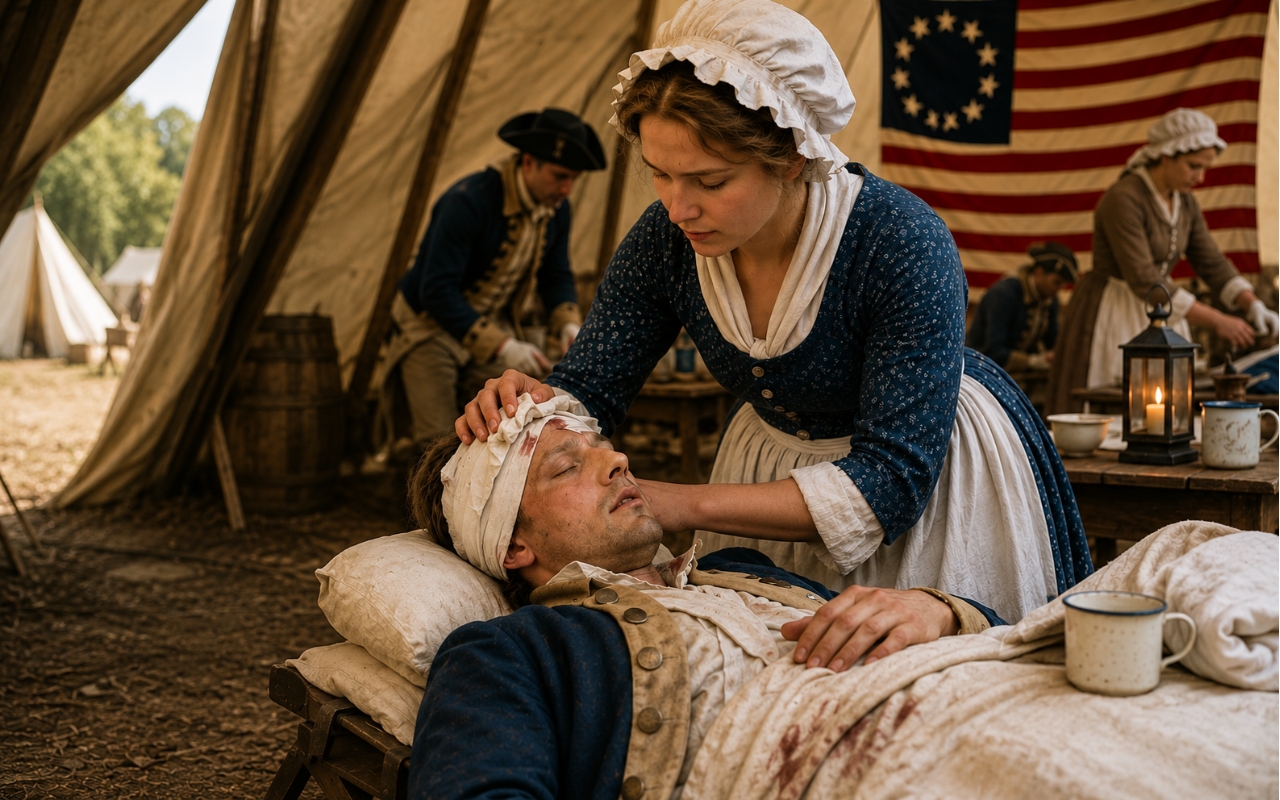
Historical accounts describe nurses washing patients, changing linens, preparing meals, administering medicines prescribed by physicians, dressing wounds, emptying chamber pots, laundering clothing, cleaning hospital wards, and comforting seriously ill or dying soldiers.
The work was physically exhausting, emotionally demanding, and often dangerous. Without these caregivers, military hospitals could not have functioned.
Recent research from the Barbara Bates Center for the Study of the History of Nursing at the University of Pennsylvania suggests these Revolutionary-era caregivers have largely been overlooked in American history. Researchers have identified approximately 150 Revolutionary War nurses by name through surviving hospital records, while acknowledging that many more almost certainly served without ever being documented.
Disease, Not the Battlefield, Was the Greatest Enemy
Although images of the Revolutionary War often focus on muskets, cannons, and battlefield heroics, historians estimate that disease claimed far more lives than combat.
Crowded military camps, contaminated water, poor sanitation, and limited medical knowledge created ideal conditions for infectious diseases to spread. Smallpox, dysentery, typhus, malaria, and other illnesses often swept through military encampments faster than the enemy could.
According to the American Revolution Institute, disease killed an estimated seven soldiers for every one who died from battle wounds. Nurses and caregivers spent as much time treating illness as they did tending injuries.
Although those conditions seem unimaginable today, the priorities would feel familiar to modern nurses. Long before infection prevention became a science, caregivers understood the importance of keeping patients clean, providing food and water, changing bedding, and remaining at the bedside. They could not identify bacteria or viruses, yet they recognized that attentive care often made the difference between life and death.
George Washington Recognized That Prevention Could Save Lives
One of the most significant public health decisions of the Revolutionary War came not on the battlefield, but in the fight against smallpox.
Smallpox posed an enormous threat to the Continental Army. Soldiers living in crowded camps were especially vulnerable to outbreaks that could devastate entire regiments.
Like many physicians of his era, General George Washington initially worried about the risks associated with inoculation. Eventually, he concluded that failing to act posed an even greater threat to the Continental Army.
In 1777, Washington ordered a widespread inoculation program for Continental troops. Historians now consider the decision one of the most important public health actions of the Revolutionary War, helping preserve the fighting strength of the Continental Army while reducing the impact of one of the era’s deadliest diseases.
Medicine Looked Very Different in 1776
There were no antibiotics to treat bacterial infections, and even minor wounds could become life-threatening if they became infected. Surgeons operated without anesthesia, relying on speed and physical restraint as patients endured painful procedures fully awake. Germ theory had not yet been established, so physicians and caregivers did not understand how microorganisms caused disease or how infections spread.
Medical treatments often included herbal remedies, bloodletting, purging, and other therapies that reflected the scientific understanding of the eighteenth century. For soldiers with catastrophic limb injuries, amputation was sometimes the only chance for survival. Performed with basic instruments and without anesthesia, these operations demanded extraordinary speed and endurance from both surgeon and patient.
Despite these limitations, physicians, surgeons, nurses, and caregivers continued treating the sick and wounded under extraordinarily difficult conditions. They improvised when supplies ran short, adapted to overcrowded hospitals, and cared for patients despite constant exposure to infectious disease.
A Legacy That Deserves to Be Remembered
Modern nursing was still decades away, but historians now recognize the Revolutionary War as an important turning point in the organization of healthcare in America.
The men and women who cared for the sick and wounded in 1776 could never have imagined today’s nurses working in trauma centers, neonatal intensive care units, operating rooms, helicopters, schools, research laboratories, or through virtual care technologies.
But they would have recognized the heart of the profession: caring for another human being has always required knowledge, endurance, compassion, and an unwavering commitment to serve, especially during times of uncertainty.
Those values have endured for 250 years.
So what happened if someone became sick on July 4, 1776?
The answer is the same today as it was 250 years ago.
Ordinary people doing extraordinary work cared for them.
They had no RN after their names. No nursing degrees, no modern monitors, and no antibiotics. Yet through long days, dangerous diseases, and the hardships of war, they cared for a nation struggling to find its footing.
As fireworks light the skies this Independence Day, they also shine on a quieter chapter of American history—one written not by generals or statesmen, but by the largely forgotten caregivers whose steady hands helped sustain a young nation when it needed them most.
