


Estimated reading time: 4 minutes
A groundbreaking clinical trial has demonstrated that CAR T-cell therapy may offer new hope for some of the most difficult kidney transplant candidates in the United States.
Researchers at the University of Pennsylvania used engineered CAR T-cell therapy to lower dangerous immune antibodies in two highly sensitized kidney patients. This allowed both individuals to finally receive kidney transplants after years without donor matches.
The findings, published in the New England Journal of Medicine, mark the first time CAR T-cell therapy has been used to help patients access organ transplantation rather than treat cancer.
The early trial suggests CAR T therapy could expand transplant access for patients previously considered nearly impossible to match.
A Major Barrier in Kidney Transplant Care
Over 91,000 Americans are currently seeking a kidney transplant. Approximately 5,000 of these individuals are categorized as “highly sensitized,” signifying their immune systems contain extremely elevated antibody levels that would attack the majority of donor kidneys.
These patients often have a Calculated Panel Reactive Antibody (cPRA) score of 99.9% or higher, making them compatible with fewer than 1 in 1,000 donor kidneys.
Traditional desensitization strategies, including plasma exchange and antibody-blocking drugs, often prove ineffective in the most challenging cases.
“This is the first demonstration that CAR T cells can be used not only to treat cancer, but also to help patients who previously had no opportunity to receive a compatible donor kidney,” said Ali Naji, MD, PhD, the Jonathan E. Rhoads Professor of Surgery and principal investigator of the study. “For patients who have spent years on the kidney transplant waiting list, this approach could be transformative.”
Repurposing Cancer Therapy for Transplant Medicine
The Phase I clinical trial, the initial phase focused on safety and feasibility, involved collaboration between researchers at Penn Medicine, NYU Langone, and Mass General.
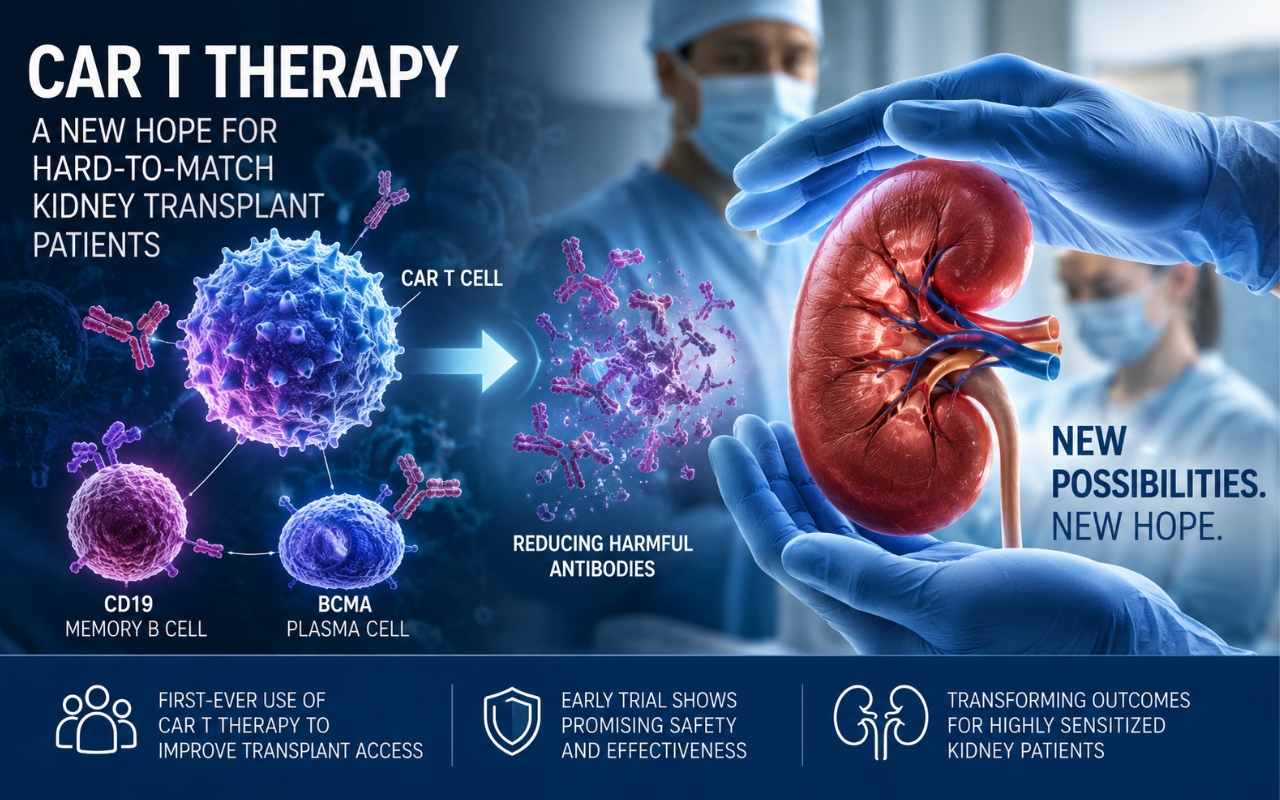
The experimental regimen merged two CAR T-cell treatments targeting distinct immune cells that produce harmful antibodies. Scientists applied CD19-directed CAR T cells to eliminate memory B cells and BCMA-specific CAR T cells to eradicate antibody-producing plasma cells.
By targeting both cell types, investigators aimed to make previously incompatible donor kidneys viable.
The two Penn Medicine patients enrolled in the study had cPRA levels near 100% and had spent years on transplant waiting lists without a single acceptable donor match.
After therapy, both patients became eligible for donor matches that had previously been unattainable. Each ultimately received a successful kidney transplant.
Thus far, researchers note neither patient has exhibited donor-specific antibody rebound or organ rejection.
Early Results Show Promise
“In this early trial, the CAR T-cell treatment was tolerated well, with no severe side effects. The immune system began to recover as expected,” said study co-author Robert Montgomery, MD, PhD, chair of the Department of Surgery at NYU Grossman School of Medicine and director of the NYU Langone Transplant Institute. “This early success reflects what’s possible when teams across institutions push the boundaries of what cell therapy can do for transplant medicine. This treatment opens up new options for patients and could save thousands more lives every year.”
Researchers indicated that immune cell depletion was temporary, with normal B-cell populations gradually restoring over time.
Future phases of the trial will test higher CAR T-cell doses and enroll larger patient populations to further evaluate safety, durability, and long-term effectiveness.
After Years Without a Match, a Third Kidney Transplant Became Possible
Philadelphia resident Andrew Boyd, a trial participant, lived with kidney disease for over forty years.
After being diagnosed with focal glomerulosclerosis at age 14, Boyd underwent two kidney transplants—one in 1993 and another in 2009.
By 2018, rising antibody levels began to threaten his second transplant, leaving almost no donor options.
“I tried to stay hopeful,” Boyd said, “but I was unsure if a third transplant was possible.”
After joining the CAR T-cell study, Boyd underwent testing, cell collection, treatment, and dialysis.
Weeks after receiving engineered immune cells, his antibody levels dropped, and by August 2025, he received a third transplant at Penn Medicine.
Now, more than nine months after his transplant, Boyd credits the care team and study researchers.
“To have this kind of innovation happening right in my backyard at Penn, it’s hard to put that gratitude into words. I’m here today because a team believed in me, fought for me, and pushed science forward. They gave me a second chance at life… again.”
Looking Ahead
“The success of this trial underscores the extraordinary caliber of science at Penn and the power of cross-disciplinary collaboration,” Naji said.
The investigation received backing from Penn’s Center for Cellular Immunotherapies, the Gift of Life Donor Program, Blood Cancer United, the Burroughs Wellcome Fund, and the National Institute of Allergy and Infectious Diseases through the Clinical Trials in Organ Transplantation Consortium.
