In 2026, the most valuable nursing skill will not be tied to a job title or setting. It will be adaptability.
As healthcare systems confront persistent shortages, rapid technological change, and evolving models of care, nurses are reshaping careers, leadership paths, and education itself. Traditional role definitions are giving way to flexible, hybrid, and self-directed pathways that reward clinical credibility, systems thinking, and continuous learning.
What Is the Adaptive Nurse in 2026?
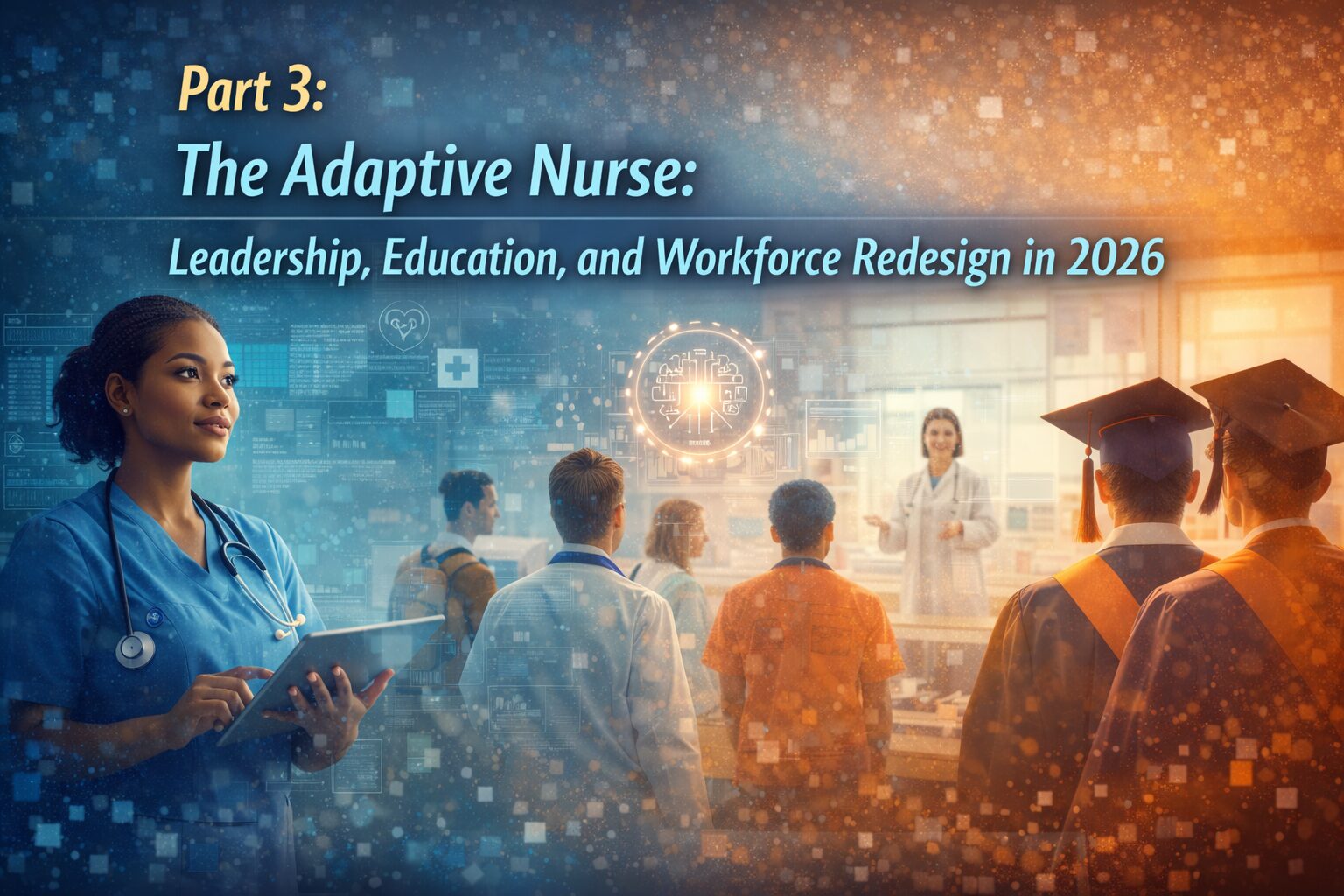
The adaptive nurse in 2026 is a clinically grounded professional who combines leadership, digital fluency, and continuous learning. Success is defined less by title and more by the ability to navigate workforce change, lead care redesign, and sustain a long-term nursing career across evolving settings.
How Nurses Are Redesigning Their Careers Beyond the Bedside
Kiara DeWitt, BSN, RN, CPN, and head of clinical operations at Medical Director Co., predicts an accelerated departure from traditional bedside roles, with nurses forming LLCs or entering independent practice settings. But she cautions that success will require legitimate education, inter-license collaboration, and real clinical competence—not shortcuts. “The ones that will do well in 2026 are the ones that act like professionals, not the ones who run away.”
Sybll Romley, corporate executive director at Briggs Home Care, highlights the value of age-diverse teams, noting that incidents are fewer when organizations pair experienced nurses with newer grads. She also sees nurses monetizing their non-clinical expertise through consulting, education, and fraud prevention—often earning more than in bedside roles. Geographic flexibility, she predicts, will favor local multi-site nurses over traditional travel models.
Why Nursing Education Must Evolve for 2026
Education leaders agree that preparation must evolve. Tracy Wilson, DNP, FNP, dean at Walden University, emphasizes that NPs are increasingly expected to lead care coordination, technology integration, and policy advocacy. Graduate education, she says, must prioritize AI fluency now.
Karen Cox, PhD, RN, FAAN, president of Chamberlain University, predicts nurses will lead care redesign efforts that balance innovation with dignity and human caring. That requires curricula that prepare graduates not just for today’s system—but for the one they will help create.
Patty Knecht, CNO at Ascend Learning, sees 2026 as a turning point for nursing education itself, with programs balancing rigor and mental well-being through clearer curriculum roadmaps, simulation, AI tools, and continuous assessment.
The Workforce Reality: Retention, Flexibility, and AI Support
From a leadership and workforce lens, Teresa Cating, DNP, MSN, A-G, NP-C, of Harrisburg University of Science & Technology, predicts ongoing shortages, increased reliance on advanced practice nurses, expanded use of AI to relieve administrative burdens, and an intensified focus on retention strategies—compensation, flexibility, advancement, and educational reimbursement.
Why Adaptability Will Define Nursing Leadership
Karen Fountain, MSN, MBA, RN, director of clinical services of Ingenovis Health, sums it up succinctly: adaptability will matter more than titles. Nurses fluent in technology and systems thinking will have greater leverage over roles, schedules, and career longevity.
Rebekah Marsh, BSN, RN, CCRN, president of AACN, calls 2026 a year of action—urging nurses to pursue credentials, leadership, collaboration, and self-care. With new staffing standards and workforce initiatives underway, she stresses that nurses must remain at the table, particularly as AI tools expand in critical care.
Series Conclusion: Across every prediction, one truth stands out: the future of nursing will not be built without nurses leading it. In 2026, the profession is not simply adapting—it is redesigning healthcare itself.
