

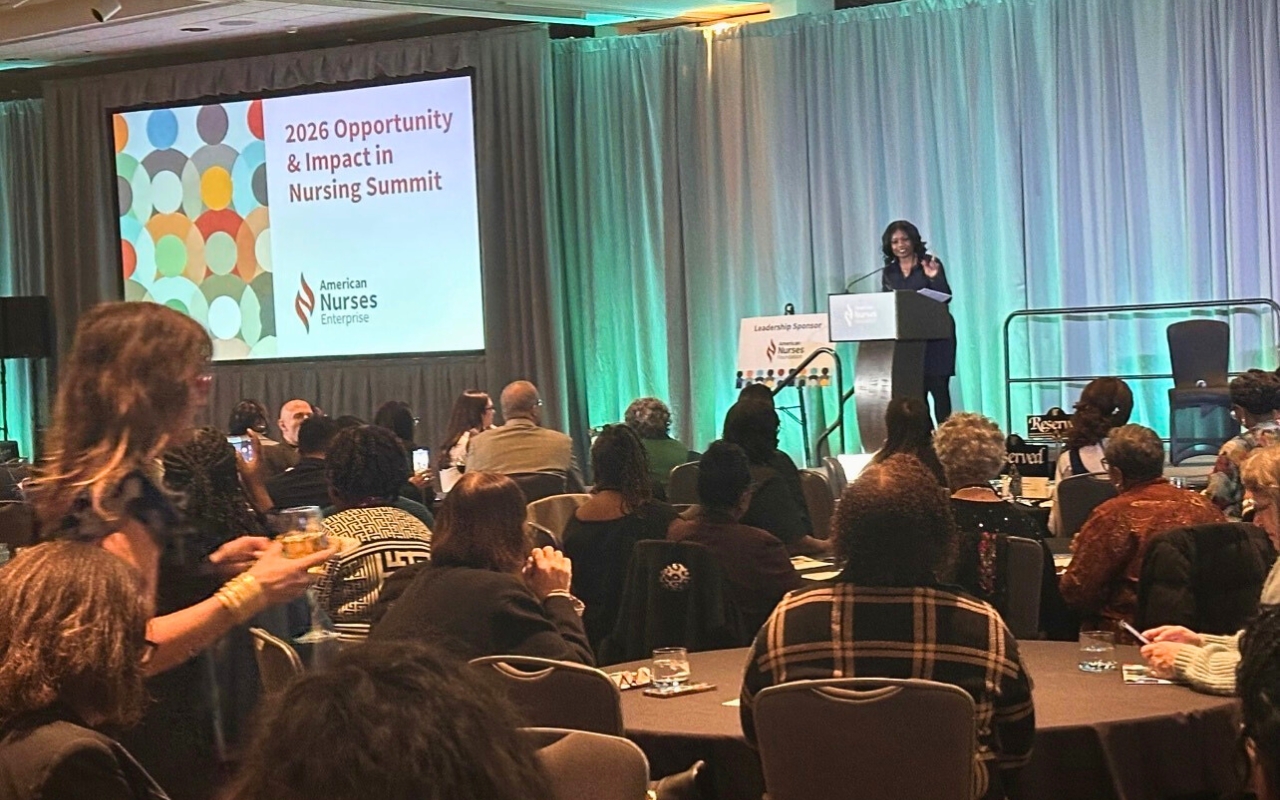

At the American Nurses Enterprise (ANA) Opportunity and Impact Summit in Washington, DC, in Feb., Katie Boston-Leary, PhD, MBA, MHA, RN, NEA-BC, FADLN, FAONL, FAAN, Senior Vice President of Equity & Engagement at American Nurses Enterprise (ANA), delivered a clear message to nurse leaders: in today’s healthcare environment, neutrality is no longer an option.
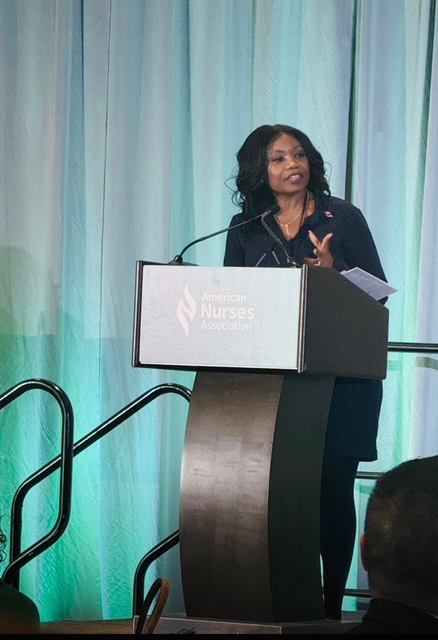
“There are moments in history when neutrality is not an option,” Boston-Leary said. “Moments when the cost of doing nothing is far greater than the risk of doing something. We are living in one of those moments.”
Her remarks focused on the growing urgency around equity, leadership, and the systems shaping the nursing workforce.
Moving Beyond Symbolic Change
Framing the summit’s theme, Boston-Leary emphasized that progress requires more than intention.
“Opportunity without impact is symbolic. And impact without opportunity is unsustainable,” she said.
She cautioned that healthcare organizations often stop short of meaningful change.
“Too often, we stop at the invitation. We celebrate representation without changing conditions. We applaud resilience without removing barriers.”
Her remarks pointed to a broader concern: visible progress does not always translate into structural change.
Historical Context and Present-Day Systems
Drawing on a visit to Ghana’s coastal slave forts, Boston-Leary described the “Point of No Return” as more than a physical location.
“The violence was not just physical—it was psychological. It was intentionally systemic and calculated,” she said.
She connected that history to present-day healthcare systems, where unclear policies and shifting expectations can test endurance rather than support growth.
“Many people today are still being held at modern-day points of no return,” she said, describing environments that “move goal posts” and create ongoing uncertainty.
Leadership as Collective Responsibility
Boston-Leary urged nurse leaders to think beyond individual effort toward coordinated action, drawing parallels to the Underground Railroad’s structure.
“It wasn’t led by one person. It was a network of people—of collective courage, of strategy, and shared risk,” she said.
She challenged attendees to consider their role in building systems that expand access and opportunity.
“What role are you willing to play?”
From Statements to Systems
Throughout her remarks, Boston-Leary emphasized that statements alone do not drive change.
“Diversity statements don’t move people to freedom—access does. Protection does. Investment does,” she said.
She underscored the distinction between intention and action.
“Opportunity is the on-ramp. Impact is the destination,” she said.
As healthcare continues to navigate workforce pressures and evolving expectations, she framed the current moment as a turning point.
“This is not a waiting moment. This is a building moment,” she said.
A Defining Moment for Nursing
Boston-Leary closed with a call for accountability, emphasizing that progress will be measured by what is built—not what is intended.
“History will not ask what we intended. It will ask what we did. It will ask what we built,” she said.
Read Dr. Boston-Leary’s full speech below.
Yesterday, we grounded ourselves in truth – truth about lived experiences, systems that fall short, and the courage nurses demonstrate every day by choosing to lead anyway. We engaged in brave dialogue and were reminded that equity work is not abstract; it is personal, urgent, and deeply human.
I want to begin with a truth that is uncomfortable—but necessary.
There are moments in history when neutrality is not an option. Moments when the cost
of doing nothing is far greater than the risk of doing something. We are living in one of
those moments.
This summit is about Opportunity & Impact – but for a reason. Because opportunity without impact is symbolic. And impact without opportunity is unsustainable.
Last year, I visited Ghana and went to the coast, to the forts where slaves were traded. I stood at one of the most abhorrently critical sites of the forced journey called the Point of No Return.
Many people think of that place as a single doorway. A final step onto a ship.
But what history teaches us, what many don’t know, is that enslaved Africans were often held in dark, confined spaces for weeks, sometimes up to 3 months, before ever boarding a ship. They were confined deliberately. Not just to detain them but to break their spirit. It was to observe and determine who was “strong enough” not only to withstand the journey but also for the inhumane forced labor ahead once they arrived. And, killed those who resisted before they crossed the exit point, and only then were they put on ships. The violence was not just physical – it was psychological. It was intentionally systemic and calculated.
The Point of No Return was not just a place – it was a process. It was a system designed to strip people of hope, agency, identity, and a future. We would like to believe we’ve left systems like that behind, but if we’re honest, many people today are still being held at modern-day points of no return. They’re not behind stone walls, but they are being held captive by unclear and uninformed policies that reintroduce historic practices by moving goal posts and by enforcing ever-changing rules. Like the captured people on the shores of Ghana centuries ago, the questions remain the same…..
Can you endure this? How much can you tolerate? How long will you stay silent?
Today, especially in healthcare, we are being tested, worn down, and filtered out; not because we lack talent and certainly not because we lack commitment. But because the systems were never built with some of us in mind.
And that’s why opportunity matters, and that’s why impact is urgent. During slavery, there was a response to those systems. It was called the Underground Railroad.
It wasn’t a railroad.
It wasn’t underground.
And it wasn’t led by one person, even though we hear so much about Harriet Tubman, but it was a network of people, of collective courage, of strategy, and of understanding and undertaking shared risk. The underground railroad was made up of conductors, safe houses, signals, and trust. And most importantly, it was built by people who believed that freedom was worth disrupting the status quo. Today, I believe we are being called to build a modern Underground Railroad – not to escape but to disrupt systems that constrain potential. It is also not to flee geography but to move people toward belonging, opportunity, and leadership.
So what does today’s Underground Railroad look like? It looks like a mentorship that opens doors instead of guarding them. It looks like sponsorship that speaks your name in rooms you’re not in. It looks like policies that don’t just sound equitable but actually produce equitable outcomes. It looks like leaders who understand that neutrality is not kindness and silence is not safety. It looks like institutions are willing to redesign, not just rebrand. It’s about not just relying on probability, which is what happens by chance, but possibility, which comes by action.
So, let’s be clear:
Diversity statements don’t move people to freedom – access does. Protection does. Investment does. Opportunity is the on-ramp. Impact is the destination. Opportunity says, “You can come in.” Impact says, “You can thrive, lead, and shape what comes next.” And much too often, we stop at the invitation. We celebrate representation without changing conditions. We applaud resilience without removing barriers. And, we admire courage without sharing risk. It is important to understand that these are distractions, not a railroad, but it’s a holding cell.
The original Underground Railroad worked because people understood their key roles. Some were conductors. Some were station masters. Some provided resources. Some provided cover. Many people from various walks of life did something. So, today, the question is not “Do you care about opportunity and impact?” The question is: What role are you willing to play?
Don’t just talk about it, be about it.
Are you willing to interrupt a process that breaks spirits before it ever breaks rules?
Are you willing to redesign pathways—not just measure attrition?
Are you willing to move beyond comfort into commitment?
We are at an inflection point.
A moment where progress is being questioned. This is our “where were you when” moment. Where equity is being reframed as excess. Where inclusion is being politicized instead of humanized. And in moments like this, history shows us something important.
Progress doesn’t disappear all at once. But erodes quietly when people decide it’s safer to wait. The unclear rules are intentionally vague to keep you in suspense. This CANNOT be a waiting moment. This is a building moment.
The people who built the original Underground Railroad didn’t wait for permission. They didn’t wait for consensus. They didn’t wait for perfect conditions. They built anyway. And today, we are being asked to do the same. To build systems that liberate potential instead of testing endurance. To create environments where people don’t have to prove they’re “strong enough” to belong. To ensure that no one is held mentally, professionally, or structurally at a modern-day point of no return.
Opportunity is not charity. Impact is not accidental. They are choices. Hard choices. And when aligned, they become a transformation. So let this summit be more than a conversation. Let it be coordination. Let it be construction. Let us leave here knowing our role in building today’s Underground Railroad:
One policy at a time.
One leader at a time.
One courageous decision at a time.
Because history will not ask what we intended. It will ask what we did. It will ask what we built. Thank you.
