

Estimated reading time: 4 minutes
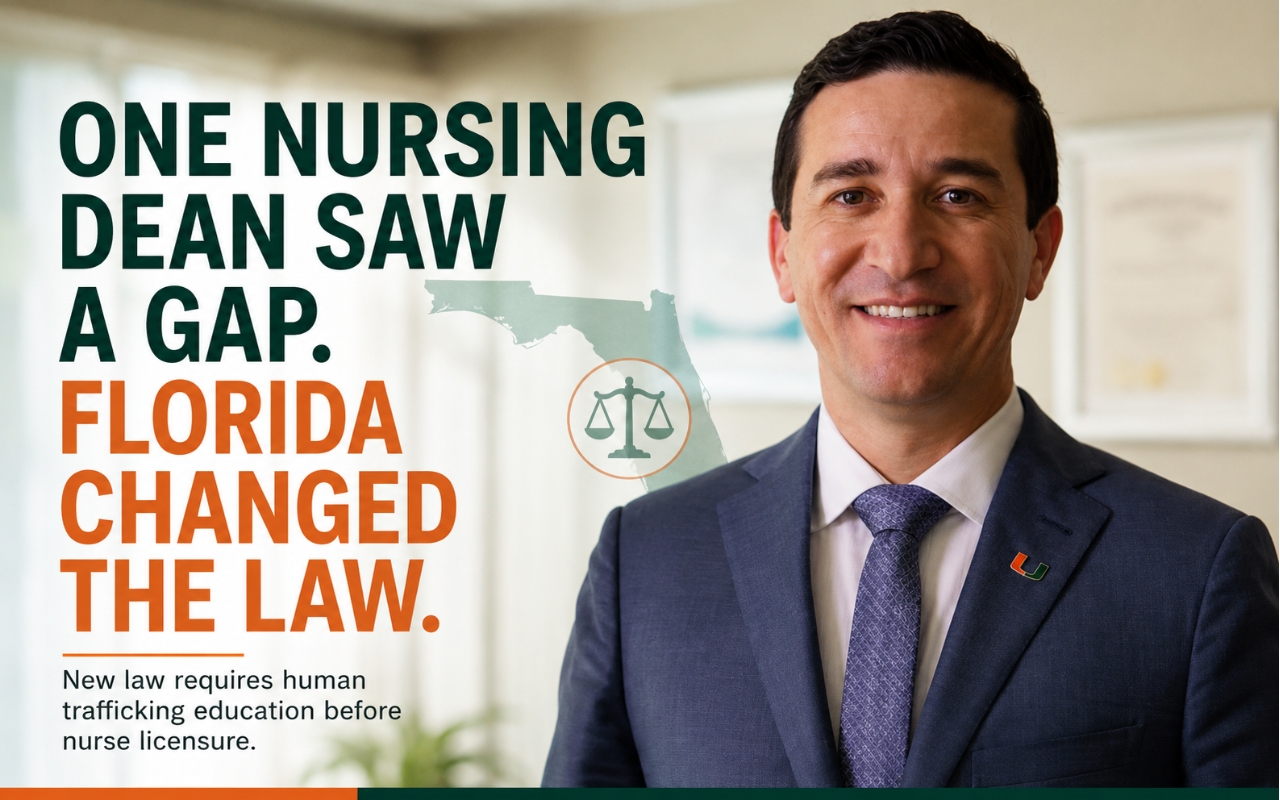
One nursing dean saw a gap in how Florida prepared new nurses for practice. Less than two years later, his proposal became state law.
Future Florida nurses will soon be required to complete human trafficking education before becoming eligible for licensure under a new state law inspired by advocacy from Hudson Santos, dean of the University of Miami School of Nursing and Health Studies. Governor Ron DeSantis approved the legislation, and it took effect July 1.
Before the law’s passage, about 20,000 Florida nursing graduates each year could become licensed without completing the required human trafficking education. Beginning July 1, 2027, nursing students applying to take the NCLEX must complete a two-hour human trafficking education course before they can sit for the licensing exam.
Turning an Idea Into Law
According to the University of Miami, Santos recognized that Florida’s existing law required nurses to complete human trafficking education only when renewing their licenses, allowing newly licensed nurses to practice for up to two years before receiving the education. Believing nurses should receive the education before entering practice, he called for the change during the 2025 Annual State Attorney’s Office Forum on Human Trafficking.
“Nurses go into practice without a requirement for human trafficking training until two years later, when they must renew their license. Our goal is to close that gap,” said Santos.
The bipartisan legislation, SB 340/HB 303, passed the Florida House unanimously, 113-0, before being approved by Governor DeSantis. It was sponsored by Senator Gayle Harrell (R-Stuart) and Representative Robin Bartleman (D-Weston).
Santos credited nationally recognized human trafficking survivor advocate Heidi Schaeffer, M.D. ’98, a visiting scholar at the School of Nursing and Health Studies and Miller School of Medicine alumna, with connecting him to key lawmakers who helped advance the proposal.
Closing the Training Gap
Representative Robin Bartleman said the change ensures nurses receive the training before they begin caring for patients.
“By ensuring nurses receive this critical training before entering the workforce, we are equipping them with the tools they need to identify victims of human trafficking and help connect them to safety and support,” said Representative Bartleman.
Senator Gayle Harrell said the legislation has the potential to save lives.
“CS/SB 340 will provide nursing students with the tools to recognize the indicators of human trafficking and safely intervene. It will truly save lives.”
Why It Matters
Human trafficking is defined as the recruitment, harboring, or transfer of people through force, fraud, or coercion for the purpose of commercial sex or forced labor. Authorities estimate that at least 50 million people worldwide are affected.
Healthcare settings often provide one of the few opportunities for victims to interact with professionals outside the control of traffickers. Nurses working in emergency departments, clinics, primary care practices, and other settings may be among the first to recognize the physical, psychological, and social indicators of trafficking and connect patients with appropriate resources.
According to the University of Miami, Florida has the nation’s third-highest rate of reported human trafficking cases.
Building the Curriculum
While advocating for legislative change, the University of Miami School of Nursing and Health Studies also expanded its efforts to prepare future nurses.
Over the past five years, Deborah Salani, director of the school’s psychiatric mental health nurse practitioner program, and faculty member Beatriz Valdes, both members of the Miami-Dade State Attorney’s Office Human Trafficking Task Force, have taught approximately 1,250 nursing students through a simulation-based curriculum focused on recognizing and responding to trafficking in clinical settings.
University of Miami Miller School of Medicine nurse scientist JoNell Efantis Potter praised the faculty’s work.
“Dr. Valdes and Dr. Salani have been doing a phenomenal job with education from day one. Their latest contribution is extraordinary.”
Earlier this year, the university launched a free online human trafficking training course that provides two Continuing Nursing Education contact hours. The statewide course was made possible through support from donor Maria Lamas.
Quoting Holocaust survivor Elie Wiesel, Lamas said: “Neutrality helps the oppressor, never the victim.”
Nursing Leadership in Action
For Santos, the effort began with identifying a gap in nurse education. Starting with future nursing graduates applying for licensure in 2027, that idea will help shape how new Florida nurses enter practice, better equipping thousands to recognize the signs of human trafficking and connect victims with safety and support.
