

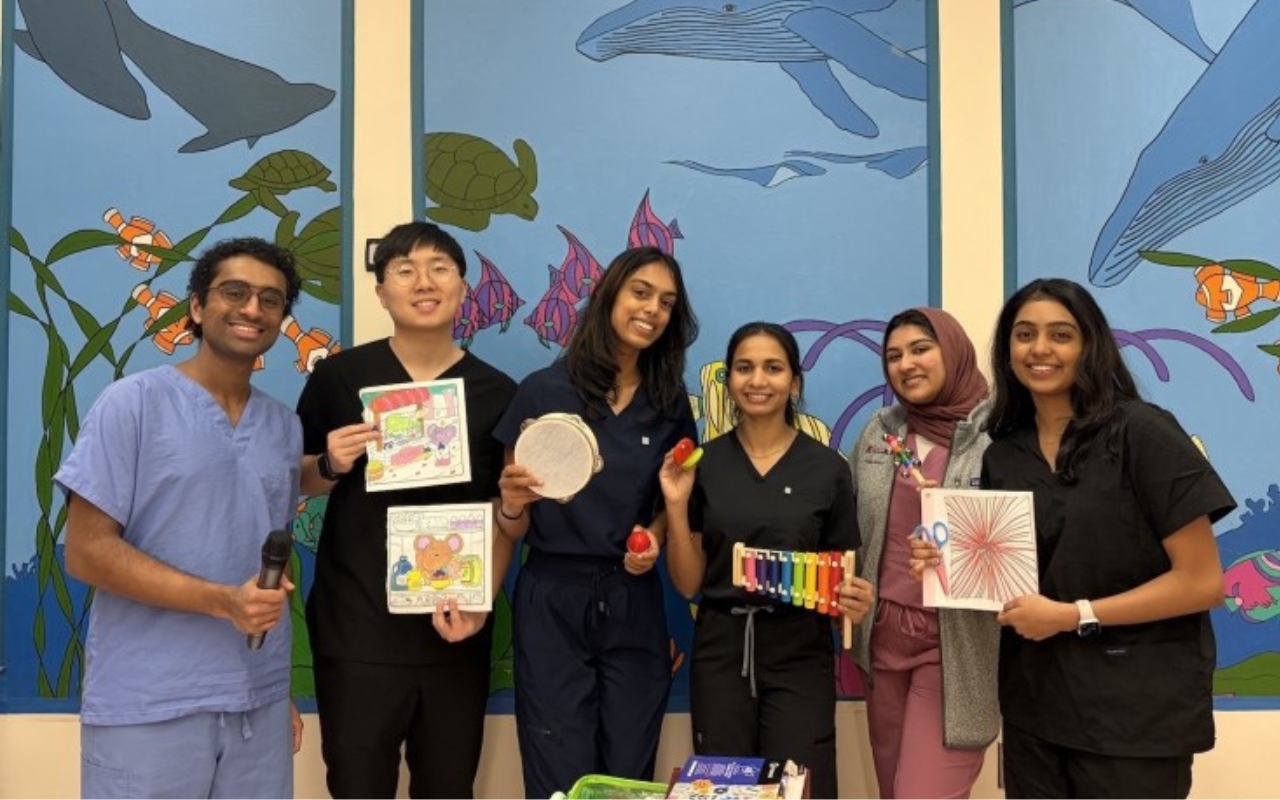

Medical students at Rutgers New Jersey Medical School have introduced a structured bedside arts and music program for pediatric patients at University Hospital in Newark, embedding creative engagement into inpatient care to support emotional well-being alongside clinical treatment.
The initiative, Healing Hues & Harmony, was founded in 2025 by third-year medical students Sneha Gandhi and Shivani Srivastava. Through trained volunteers, the program delivers age-appropriate art and music activities directly to hospitalized children and their families.
Healing Hues & Harmony is a student-led pediatric enrichment program at Rutgers New Jersey Medical School that provides bedside art and music sessions for patients at University Hospital in Newark. The initiative integrates creative engagement into inpatient care to promote emotional regulation and family-centered support.
Addressing Isolation in Pediatric Hospitalization
Healing Hues & Harmony emerged after Gandhi and Srivastava observed how isolating and overwhelming hospitalization can be for children, particularly those admitted long-term or facing language barriers.
“It is a student-led arts and music enrichment initiative created to support pediatric patients and families at University Hospital. We started this program because we believe children are meant to play and not feel defined by hospital beds, IV lines, and constant procedures,” said Gandhi.
While rotating through pediatrics, the students saw that although medical needs were being met, many children lacked opportunities for play, creativity, and interpersonal connection. They also noticed that distraction could help children tolerate treatments or briefly shift their focus away from discomfort and fear.
With support from the Pozen Program at Rutgers NJMS, which funds student-led community service initiatives, Healing Hues & Harmony launched in August 2025. Trained medical student volunteers now deliver bedside activities designed to engage children across developmental stages.
Integrating Emotional Wellness into Clinical Care
Hospitalization can disrupt a child’s sense of control and routine. Creative engagement offers a way to restore some autonomy within the clinical environment.
Gandhi said hospitalization often strips children of their sense of control, routine, and identity. Art and music help restore some of that. When a child chooses a color, folds origami, or sings along to a familiar song, they are creating something of their own.”
“Wellness is part of healing, just as much as medications and procedures. Art and music also transcend language, allowing connection with patients and families even when words fall short,” she added.
For healthcare professionals working in diverse urban communities such as Newark, the ability to connect across language barriers is particularly significant.
Impact on Patients and Families
Since the program’s launch, the founders have reported visible improvements in patient engagement.
Since launching, Gandhi said they’ve seen a clear emotional impact on patients and families. Children who initially appear withdrawn or distressed often become engaged once an activity begins. Many patients hospitalized for weeks or months share how much they appreciate the company and the chance to do something enjoyable.
Parents have also described the benefits.
“Parents frequently tell us that seeing their child calm down or smile provides relief. In several cases, families shared that art or music helped their child relax during difficult moments, such as treatments. Often, parents and siblings join in, turning the visit into a shared positive experience,” Gandhi said.
Educational Value for Future Physicians
The initiative also provides formative experience for participating medical students.
“It allows medical students to connect with patients beyond traditional clinical roles. By spending time with children outside of exams and procedures, we learn how powerful small, nonmedical interventions can be,” said Srivastava
She added that volunteers gain experience engaging patients across ages and developmental stages, working with interpreters, and supporting families during vulnerable moments. These experiences reinforce the importance of seeing patients as whole individuals, not just diagnoses.
Illustrative Moments at the Bedside
Srivastava shared examples that demonstrate the program’s impact.
“During one visit, a young patient who had been crying continuously while on a nebulizer gradually calmed down after engaging with coloring materials, giving the parents a rare moment to relax. In another instance, an 8-year-old, who initially refused to speak, began opening up after drawing her favorite TV characters and displaying the artwork in her room,” she said.
Srivastava also noted that infants have responded to music and that patients facing language barriers have bonded with volunteers through shared creativity.
Looking Ahead
Srivastava expressed hope for the program’s sustainability.
“Our hope is for it to become a sustainable part of pediatric care at University Hospital, complementing existing support by offering additional one-on-one creative time. More broadly, we hope the program reinforces that healing is both medical and emotional, supporting children and families while shaping compassionate future physicians.”
As healthcare systems continue to prioritize patient experience, equity, and holistic care, Healing Hues & Harmony offers a model for integrating emotional support into inpatient pediatric settings without disrupting clinical workflow.
