

Estimated reading time: 4 minutes
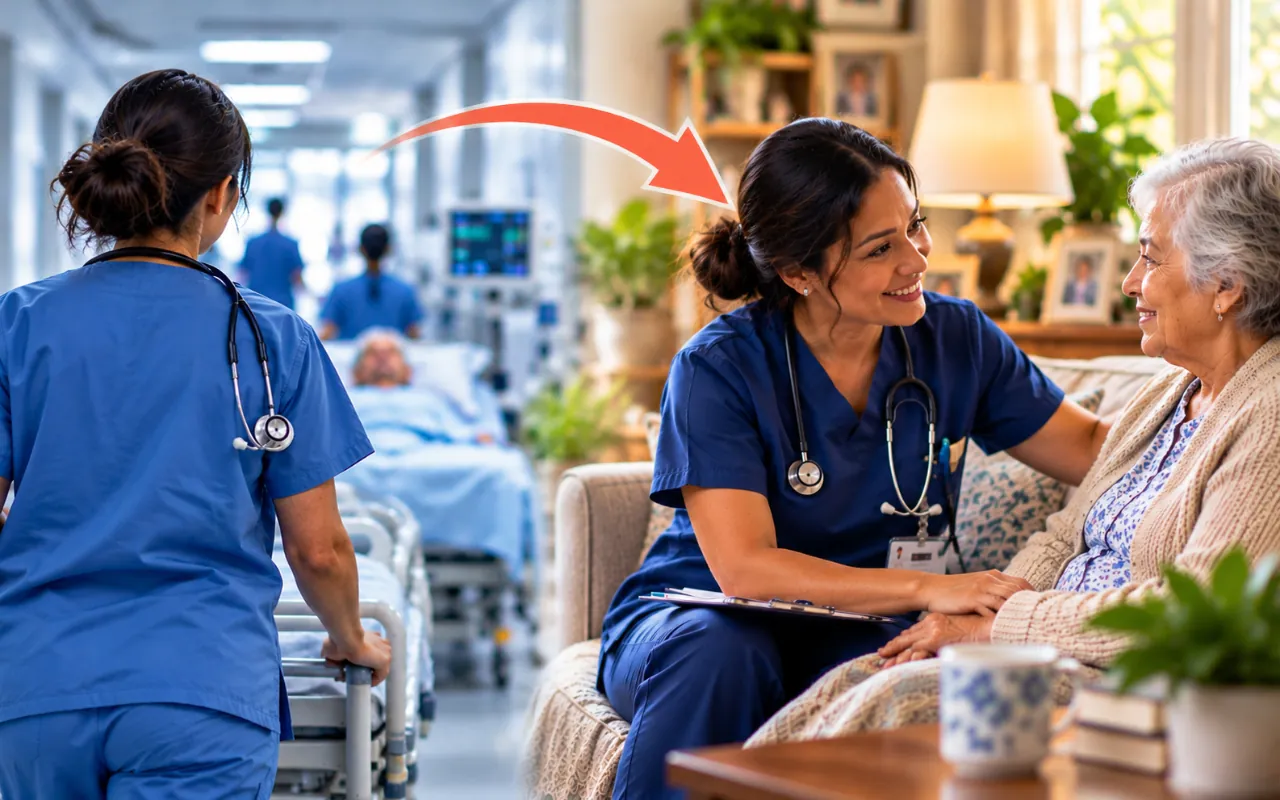
Hospitals once accounted for the largest share of nursing malpractice claims. Today, according to data released by Nurses Service Organization (NSO), the patient’s home has taken the top spot.
In 2009, hospital inpatient settings accounted for 38.2% of closed nursing malpractice claims in NSO’s reporting, compared with 12.7% involving care in patients’ homes. By 2025, that distribution had shifted significantly. The patient’s home accounted for 21.5% of closed claims, making it the leading setting, while hospital inpatient claims represented 11.6%.
These findings reflect changes in where nurses deliver care and raise questions about professional liability as more patients receive complex treatments outside traditional healthcare facilities.
Lynn Pierce, MSN, APRN, FNP-C, senior risk manager for NSO, says home healthcare presents distinct challenges for nurses.
“The home is an increasingly common and complex setting for nursing care. As more patients receive advanced treatments outside of hospitals, nurses are taking on greater responsibility and risk in the home environment.”
Want to see more Nurse Approved articles in your Google results? Add us as a preferred source.
Add Nurse Approved as apreferred source on Google
Why Home Healthcare Presents Different Risks
Unlike hospital nurses, who typically work alongside other healthcare professionals, home healthcare nurses may be the only clinicians present when a patient’s condition changes.
That independence can complicate decisions about when symptoms require urgent intervention, particularly without immediate access to colleagues or institutional resources.
Pierce identifies environmental hazards and the responsibility of providing care without direct on-site supervision as factors contributing to professional liability risks in home healthcare.
Home healthcare nurses may also serve as the primary point of communication between patients, families, and other healthcare professionals, making timely assessment and communication especially important.
According to Pierce, the average total incurred cost for claims involving home healthcare nurses was $301,031 in NSO’s latest claims data.
Although the proportion of closed claims involving patients’ homes has increased, the figures do not establish that individual home healthcare nurses are more likely to face malpractice claims than nurses practicing in hospitals. Instead, they show how the distribution of closed claims across care settings has changed.
One Nursing Liability Risk Has Remained Consistent
Despite significant changes in nursing practice, the leading category of malpractice allegations has remained remarkably consistent.
Treatment and care allegations accounted for 55% of closed claims in NSO’s first report in 2009. In the 2025 report, they represented 56.2%.
That consistency is notable as nurses take on broader clinical responsibilities and provide care in outpatient facilities, schools, patients’ homes, and telehealth settings.
Nurse practitioners, in particular, have expanded responsibilities involving diagnosis, treatment, and prescribing.
The findings underscore the continuing importance of nursing assessment, appropriate interventions, and communication, regardless of where care is delivered.
Digital Documentation Is Changing Malpractice Claims
Electronic health records, patient portals, digital communications, and artificial intelligence-assisted tools have transformed how nurses document and coordinate patient care, expanding the types of evidence that may be examined when a malpractice claim arises.
“Today, evidence in a claim can extend beyond the clinical record to include audit trails and metadata, patient portals, emails, text messages, videos, and data generated by medical devices. When that digital evidence does not align with the nurse’s clinical documentation, it can create challenges from a defense perspective.”
For nurses, this means the clinical record may be only one component of the information reviewed during litigation.
Pierce emphasizes that accurate documentation remains essential.
“Good documentation can help nurses defend themselves in a malpractice lawsuit. Documentation should be complete, correct, and timely, and should clearly reflect the nursing assessment, care plan, and response to interventions.”
AI-assisted and voice-activated documentation raise additional concerns because automatically generated notes may be inaccurate or fail to reflect the care provided.
Pierce advises nurses to review technology-generated documentation and verify its accuracy rather than assuming the information is correct.
AI Raises New Questions About Clinical Judgment
Beyond documentation, artificial intelligence is introducing professional liability considerations as nurses increasingly encounter automated recommendations and technology-assisted clinical decisions.
Pierce cautions that AI tools may rely on inaccurate, incomplete, or outdated information.
Overreliance on automated recommendations can also erode independent clinical decision-making, especially when nurses accept information without evaluating it against the patient’s condition.
The same principle applies to remote monitoring and other technologies used outside traditional healthcare settings. Digital information can support patient assessment, but it does not replace the nurse’s responsibility to recognize changes in condition and respond appropriately.
What the Findings Mean for Nurses
NSO’s claims data illustrate how professional liability considerations are evolving as nursing care expands beyond hospitals.
Despite advances in technology, expanded nursing responsibilities, and changes in where patients receive care, treatment and care allegations continue to account for more than half of closed claims in NSO’s reporting.
For nurses, the findings reinforce the importance of sound clinical judgment, timely assessment, clear communication, and accurate documentation, regardless of where they practice.
