

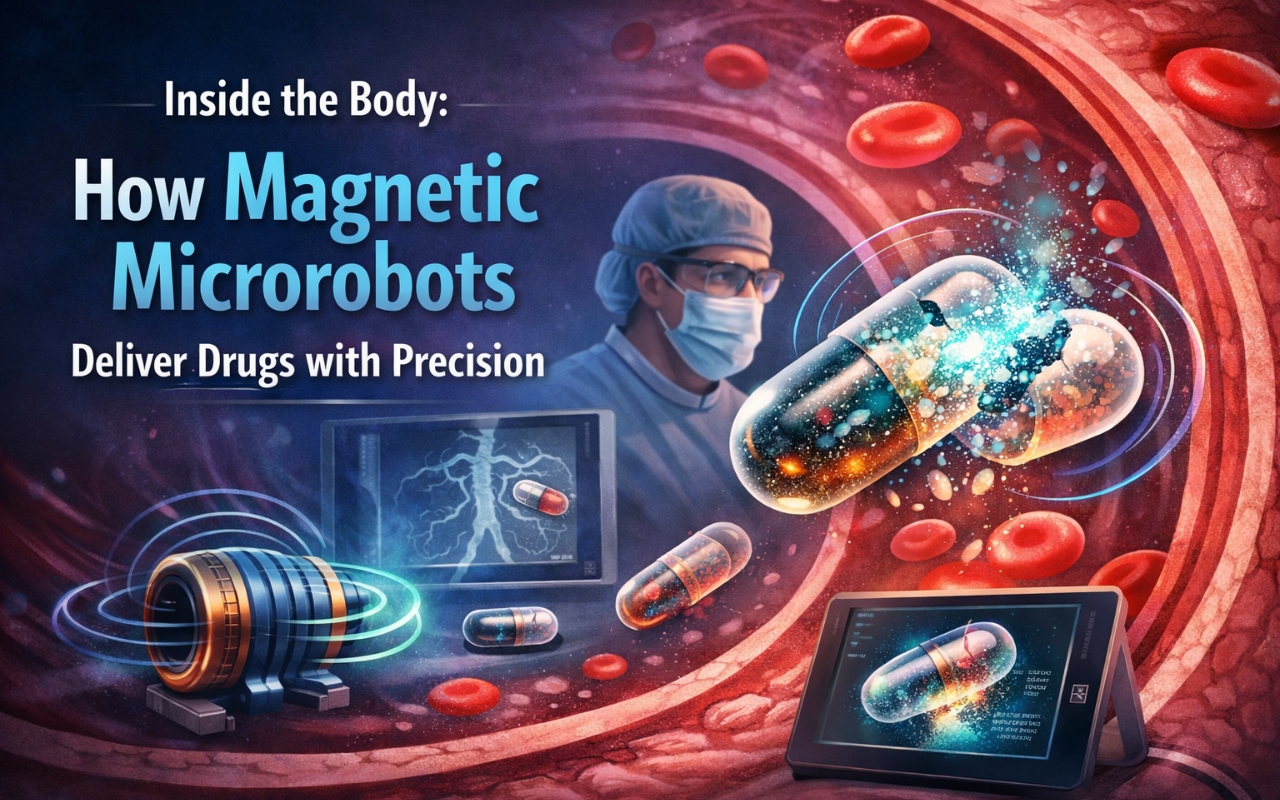

Targeted drug delivery has long been a goal in medicine, particularly for conditions where precision matters as much as potency. Researchers at ETH Zurich are now bringing that goal closer to clinical reality by developing magnetic microrobots to deliver medication directly to specific locations within the body.
How Magnetic Microrobots Navigate the Body
The research, titled Clinically Ready Magnetic Microrobots for Targeted Therapies, outlines a system that uses gelatin capsules embedded with magnetic nanoparticles. These capsules are small enough to travel through blood vessels and can be guided using external electromagnetic fields. This approach allows clinicians to steer microrobots toward a precise target rather than relying solely on systemic circulation.
Real-Time Imaging Enables Precision Control
Real-time tracking is a key part of the system. Physicians can monitor the movement of microrobots using X-ray imaging as they travel through the vascular system. Once the capsule reaches the intended site, a high-frequency magnetic field is applied. This causes the magnetic particles to heat, dissolving the gelatin capsule and releasing the medication. The release process takes approximately 40 seconds.
Tested in Large Animal Models
The research team successfully demonstrated this technology in pigs and sheep. According to the study, this marks the first time magnetic microrobots have been shown to operate in a clinically relevant environment rather than solely in a laboratory setting. Importantly for clinical translation, all materials used in the system are already approved by the U.S. Food and Drug Administration for other intravenous applications.
What This Could Mean for Nursing Practice
For nurses, this technology represents a potential shift in how therapies may be administered and monitored in the future. Targeted delivery could reduce systemic side effects, improve medication effectiveness, and require new interdisciplinary workflows involving imaging, device navigation, and patient monitoring. While the technology is still in the research phase, its compatibility with existing clinical materials suggests a clearer path toward eventual human trials and bedside use.
Engineering, Imaging, and Care Converge
As precision medicine continues to evolve, innovations like magnetic microrobots highlight how engineering, imaging, and clinical care are increasingly intersecting. Nurses will play a critical role in translating these advances into safe, effective patient care as they move closer to clinical adoption.
This story was originally shared via Instagram by @rowancheung and is based on findings published in Science.
