



When Norton West Louisville Hospital opened in late 2024, it ended a 150-year absence of hospital care in Louisville’s majority-Black West End.
At the center of that milestone is Corenza Townsend, LPN, now the hospital’s Chief Administrative Officer. Her path to executive leadership did not follow a traditional trajectory.
She is a Licensed Practical Nurse.
And she helped build a hospital.
Corenza Townsend, LPN, led the creation of the first full-service hospital in West Louisville in more than 150 years. Drawing on frontline nursing experience and business education, she challenged conventional leadership pathways and underscored the essential role LPNs play in shaping healthcare systems, access, and equity.
A Vision Rooted in Community and Data
The idea began nearly eight years before the hospital opened. At the time, Townsend was a nurse manager at Norton Healthcare when she and her team seized an unexpected moment.
“We had this plan,” Townsend explained. “It wasn’t in writing yet. We happened to see Russ Cox, our CEO, walking to the bathroom. So we stalked him outside the bathroom… Nobody thought he would actually say yes. He said, yes. He just listened to us, and he said, ‘Let’s do it. What do you need?”
What gave her the confidence to propose something that had not existed in more than a century?
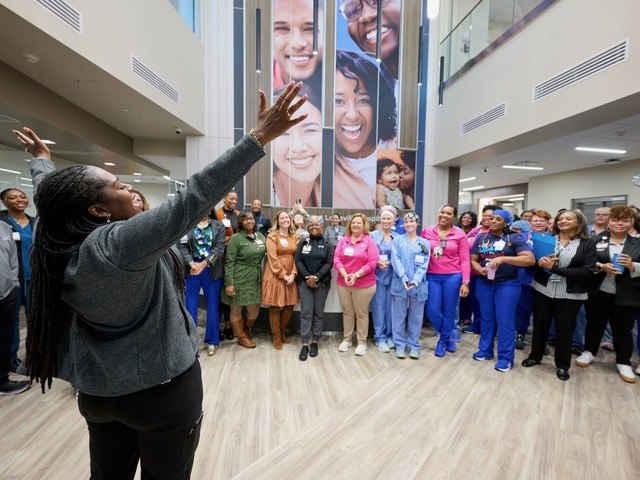
Corenza Townsend addresses staff and community members inside Norton West Louisville Hospital, a facility she helped lead into existence after a 150-year absence of hospital care in the West End.
“The courage came from clarity,” Townsend said. “West Louisville had gone 150 years without a hospital, and the data, the community voice, and the lived experience all pointed to the same truth. Doing nothing was no longer acceptable.”
The data told a sobering story.
“The life expectancy in West Louisville is about 12-and-a-half to 15 years different here than anywhere else in the city,” she said. “That alone gives you reason enough to build a hospital in West Louisville.”
This was not simply a construction project. It was a response to documented inequities in access, chronic disease burden, emergency department utilization, and gaps in preventive care.
“The need wasn’t theoretical,” she said. “It was measurable and urgent.”
Leading From the LPN Lens
Townsend joined Norton Healthcare in 2009 as a Licensed Practical Nurse and was a part of the Epic implementation team. She later moved into leadership roles, serving as Practice Supervisor and then Practice Manager of the Norton Leatherman Spine Center. In 2022, she was selected to lead the new hospital as Chief Administrative Officer.
Her LPN background remains central to her leadership.
“Starting my career as a Licensed Practical Nurse gave me a perspective I still rely on every day,” Townsend said. “As an LPN, I worked in spaces many leaders never see. Doctor’s offices, side by side with physicians, frontline administrative roles, and hospital settings. That hands-on exposure taught me how care actually moves through a system, not how it looks on paper.”
That experience shapes her strategic decision-making.
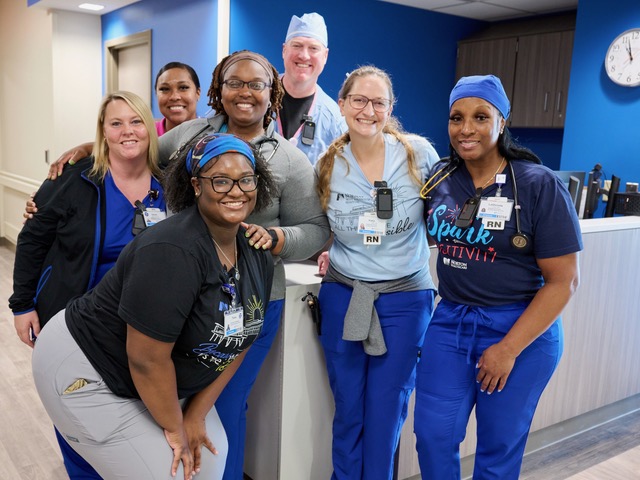
Members of the Norton West Louisville Hospital clinical team inside the new facility, reflecting the frontline workforce supporting expanded access to care in the community.
“When decisions are being made that affect an entire organization, I’m able to connect strategy to real patient and staff experiences. That vantage point keeps my leadership grounded, practical, and focused on what truly improves care.”
She committed early on to advocating for others.
“As I advanced, I would advocate for those coming behind me and help educate others.”
A Different Path to Leadership
Rather than pursue additional nursing degrees, Townsend chose to expand her expertise in business and marketing.
“I actually knew business before I knew nursing,” she said. “Even after becoming an LPN, I was drawn to understanding systems, people, and how decisions are made beyond the bedside.”
Her business education broadened her systems thinking and operational approach.

Corenza Townsend appears on stage during a public event tied to the opening of Norton West Louisville Hospital, highlighting nurse leadership in advancing healthcare equity.
“My business and marketing education has been a major disruptor, largely because it’s not a traditional pathway or skill set combination for nurses,” she said. “It challenges long-held assumptions about who leads, how decisions are made, and what expertise looks like in healthcare.”
It also required persistence.
“That said, it has meant I’ve often had to show my work more and work harder to build trust around ideas. Over time, my team and I have proven that our approach drives meaningful results.”
For LPNs who feel underestimated, she offers clear guidance.
“Don’t let anyone define your potential by your title,” Townsend said. “Healthcare needs leaders who understand how care actually works, and LPNs are uniquely positioned to influence meaningful change when they trust their voice and their value.”
Building With the Community
Community input shaped both the hospital’s mission and its design.
“The data made the inequities undeniable, but it was lived experience and community voice that gave the numbers meaning,” Townsend said.
Residents identified barriers beyond clinical care, including transportation, food insecurity, navigation challenges, and distrust of the healthcare system.

Community members gather outside Norton West Louisville Hospital during a public event, underscoring the hospital’s role as both a healthcare provider and neighborhood partner.
“Listening to residents fundamentally shaped how the hospital operates,” she said. “Community feedback made it clear that access barriers extended well beyond the exam room.”
As a result, the hospital includes transportation support, an on-site bistro, and a partnership with Dare to Care to address food access. Local art, natural light, and a workforce reflective of the community were intentional design choices.
“The people we were serving, we asked them what they wanted and what they needed. They told us, and we created it,” Townsend said.
Expanding the Definition of Nurse Leadership
Townsend is direct about the myths she hopes to dismantle.
“The biggest myth is that practical nurses are limited in impact or strategic thinking,” she said. “LPNs bring deep clinical insight, adaptability, and an understanding of how care actually functions day to day. Those skills translate well beyond the bedside.”
She also challenges the belief that leadership follows only one pathway.
“Talent, vision, and capability aren’t defined by a title or degree alone,” she said. “When we recognize and develop diverse experiences, including practical nursing backgrounds, organizations become stronger, more responsive, and more effective.”

Corenza Townsend during construction of Norton West Louisville Hospital, a project she helped lead to restore hospital access to the community after 150 years.
More than a year after opening, she reflects on what the journey represents.
“Walking the space represents persistence, preparation, and collective effort,” she said. “It’s a reminder of how far the idea traveled, from concept to reality, and the many people who made it possible along the way.”
She never doubted the outcome.
“The need was too clear, the data too strong, and the community voice too consistent. Failure was not an option.”
For nurses at all credentials and career stages, Townsend’s story expands the possibilities of leadership. In West Louisville, an LPN helped restore hospital access after 150 years and demonstrated that influence in healthcare is not confined to title. It is built on insight, preparation, and purpose.
