



Maryland Governor Wes Moore received the Health Equity Legacy Award from the American Nurses Foundation at the 2026 Opportunity and Impact in Nursing Summit in Washington, D.C., where nursing leaders, policymakers, and healthcare stakeholders gathered to examine the issues shaping the nursing profession and the future of patient care. During his remarks, Moore called on policymakers to provide “air cover” for nurses by strengthening staffing support, workforce development, and health equity initiatives.
During his remarks, Moore drew from his military experience to describe what he believes nurses need most from leadership. He referred to the concept of providing “air cover,” a term used in military operations to describe support and protection for those operating on the front lines. In the healthcare context, Moore used the phrase to describe policymakers’ responsibility to ensure nurses have the resources, staffing support, and policy environment necessary to focus on patient care rather than navigate system failures alone.
The Opportunity and Impact in Nursing Summit focused on workforce sustainability, health equity, discrimination across patient and professional settings, and the policy decisions that directly affect nurses and the communities they serve. Discussions throughout the event reflected growing concern about workforce shortages, access to care, bias in healthcare delivery, and the strain placed on nurses as healthcare systems continue to evolve.
For many in attendance, Moore’s recognition reflected not only a specific policy achievement but an acknowledgment of a leader who has publicly centered nurses in conversations about healthcare reform.
Accepting the award, Moore made clear that the recognition reflected the work of nurses in his own state.
“On behalf of all of our many nurses in the state of Maryland, I just want to say that I receive this award on behalf of you,” Moore said. “I’m so proud to be the governor of a state that has so many remarkable, remarkable nurses.”
Introducing Governor Wes Moore
For nurses who may be less familiar with his background, Moore is a Maryland native who served as a U.S. Army officer, including a deployment to Afghanistan, before serving as a White House Fellow and later leading nonprofit and business initiatives focused on economic opportunity and poverty reduction. He was elected governor of Maryland in 2022 and became the first African American to hold the state’s highest office in its 246-year history.
Moore is currently the only sitting Black governor in the United States and serves as Vice Chair of the National Governors Association, a bipartisan organization representing the nation’s governors. He has held that role since July 2025 and is expected to become Chair in 2026. His work within the NGA has focused on economic mobility, education, and infrastructure, areas he has repeatedly connected to long-term community health and stability.
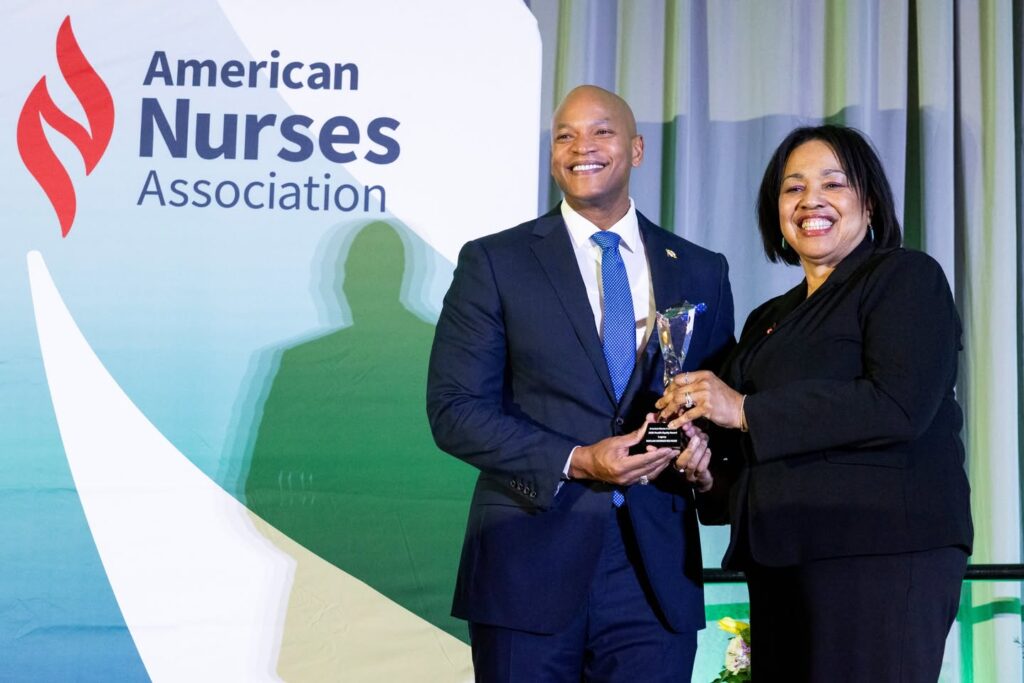
The American Nurses Foundation recognized Moore for leadership tied to health equity initiatives in Maryland, including policies developed in partnership with nursing organizations and healthcare leaders. Among those efforts is legislation requiring implicit bias and structural racism training for licensed healthcare professionals, aimed at improving patient outcomes and addressing disparities in care.
A Different Kind of Recognition
The recognition came during a week when Moore was also part of a broader national political conversation after reports circulated online that he had not been invited to the traditional governors’ dinner at the White House. Public commentary and speculation focused on political dynamics and policy differences, highlighting the increasingly polarized environment surrounding healthcare and public policy.
In contrast, the Opportunity and Impact in Nursing Summit provided a different setting. The event emphasized collaboration rather than division, focusing on the shared responsibility of improving patient outcomes and supporting the healthcare workforce. Moore’s remarks reflected that tone, focusing less on politics and more on the realities nurses face in their daily work.
“At a moment right now when things can feel very fragile, we don’t just listen to our nurses, we lift our nurses as well,” Moore said. “That should not be something that requires applause. It should just be standard.”
Speaking to the Nurse Experience
Throughout his speech, Moore acknowledged the emotional and ethical weight that nurses carry. He described nursing as work that extends beyond clinical treatment, recognizing the emotional support nurses provide to patients and families during some of the most difficult moments of their lives.
“Oftentimes, your job is not just to make sure that you are healing, but consoling,” he said. “You’re not just treating, but you’re also touching. You’re rebuilding people’s spirits, their hopefulness and their optimism.”
He also addressed the economic realities nurses witness firsthand, noting that patients struggle to balance basic needs with healthcare costs.
“Nurses so often hear their patients questioning how they’re going to be able to afford groceries while also trying to figure out how they can heal their bodies,” Moore said. “And unfortunately, for too many people, that feels like a choice.”
Moore acknowledged that nurses frequently experience the consequences of policy decisions before others do.
“In many ways, nurses will feel the consequences of policies that we’re seeing before anybody else,” he said. “And we continue to ask you to show up.”
A Personal Story Behind the Policy
Central to Moore’s remarks was a deeply personal experience that shaped his approach to healthcare and health equity. He spoke about losing his father when he was three years old after his father sought care for throat pain and later developed acute epiglottitis, a rapidly progressing and life-threatening condition.
Moore described how his mother was questioned about whether his father was exaggerating his symptoms before his condition worsened, an experience that left a lasting impression on him and influenced his views on bias and accountability within healthcare systems.
“It’s not because it sounded good or because it polled high,” Moore said. “It’s because I never want another child to have to experience what this feels like. I never want another spouse to go through what my mother went through.”
He connected that experience to broader disparities in healthcare outcomes, noting that Black Marylanders experience higher rates of preventable illness and are more likely to be uninsured. Addressing those disparities, he said, requires more than conversation.
“We have to be prepared to actually do the work,” Moore said. “Health is the pathway to everything that we hope for as a society. Because without health, none of that matters.”
Providing “Air Cover” Through Policy
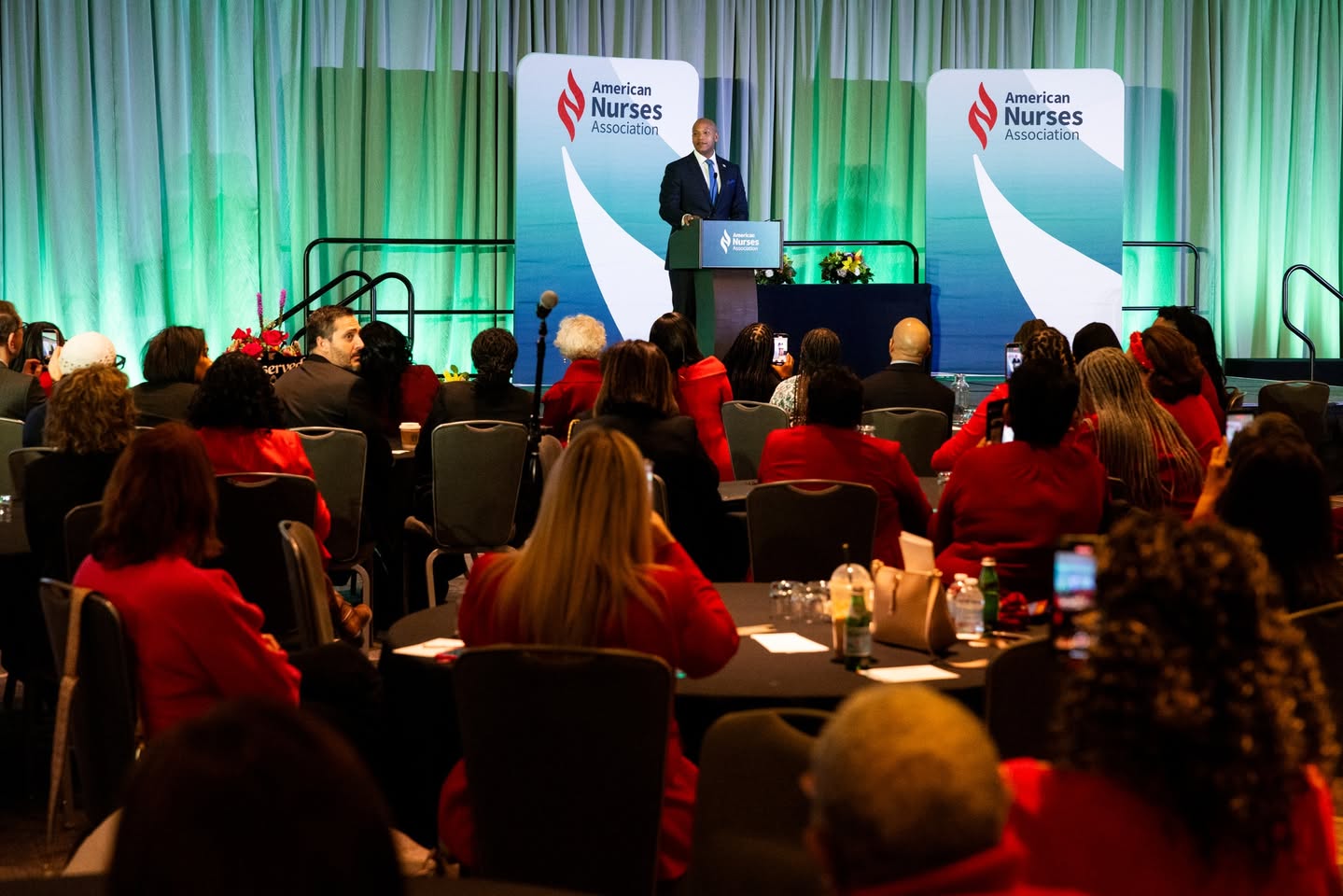
For nurses in attendance, Moore’s use of the term “air cover” resonated as a recognition that frontline care cannot succeed without structural support. His administration has pointed to investments in staffing flexibility, nurse education and faculty support, workforce pipeline development, and rural health transformation programs as examples of policy decisions shaped by listening to nurses’ concerns.
Moore framed those efforts as a responsibility of leadership to support the people providing care rather than adding to their burden.
“I thank you for being our warriors. I thank you for being our fighters,” Moore said. “History will remember those who stood up. History will remember those who truly left no one behind.”
At an event centered on opportunity and impact in nursing, the recognition underscored a message that resonated throughout the summit. Supporting patients begins with supporting the people who care for them. For many nurses in attendance, Moore’s remarks reflected an understanding that meaningful healthcare progress requires listening to the voices closest to patient care and acting on what they say.
