


It has long been said that behind every good physician stands a great nurse. After more than four decades in internal medicine and endocrinology, I can say with certainty that this is true.
The finest nurses did far more than complete clinical tasks. They modeled professionalism in action, combining clinical excellence with empathy, clear communication, adaptability, and steady judgment under pressure. They were meticulous and unwavering patient advocates, supported by systems that allowed them to practice as trained.
That was then. This is now.
Today’s nurses remain deeply committed and highly skilled, but the environment has fundamentally changed. Chronic understaffing, lingering pandemic-related trauma, escalating patient acuity, workplace incivility, and mounting administrative demands have created unprecedented strain. The emotional toll is measurable and sobering.
A 2025 survey by AMN Healthcare reports that approximately 65% of nurses experience high stress and burnout. Nearly three-quarters feel emotionally exhausted multiple times per week, and 58% feel burned out most days. Data from the American Association of Critical-Care Nurses show that 55% regularly skip meals or breaks, and 40% intend to leave the workforce or retire within five years. Among early-career nurses, 28% of Gen Z respondents report daily burnout.
These are not just statistics. They represent skilled professionals who invested years of education and sacrifice to serve others, now questioning whether they can continue to do so.
Addressing burnout requires a dual approach.
At the organizational level, meaningful change must include safer staffing ratios, competitive compensation, flexible scheduling, mental health resources, and leadership cultures that prioritize psychological safety. Supportive leadership, improved workflows, and peer connection consistently reduce burnout risk and improve retention.
At the individual level, fundamentals still matter: sleep, exercise, balanced nutrition, restorative time off, and clear professional boundaries. Yet many nurses do all the “right things” and still feel depleted.
An additional, and often overlooked, protective factor is emotional intelligence (EQ).
Emotional intelligence is the ability to recognize, understand, and manage your own emotions while effectively navigating and responding to others’ emotions. Neuroscience confirms we are emotional beings. We have a large segment of our brain, the limbic system, devoted to processing emotion. As Nobel laureate Daniel Kahneman observed, “We behave emotionally first, logically second…It’s not a gender thing or a cultural thing. It’s the human condition and costly if we don’t get it right.” EQ helps you get it right.
High EQ strengthens self-awareness, impulse control, empathy, communication, and resilience. In healthcare settings, these are not “soft skills.” They are clinical assets. Research shows that EQ training improves the core components of burnout: emotional exhaustion, cynicism/depersonalization, and personal accomplishment.
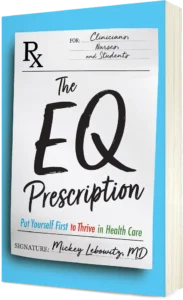
To make emotional intelligence even more practical, in my book, The EQ Prescription: Put Yourself First to Thrive in Health Care by Dr. Mickey Lebowitz
To make emotional intelligence even more practical, in my book, The EQ Prescription: Put Yourself First to Thrive in Health Care, I integrate EQ with the “Resiliency Zone,” a concept developed by trauma specialist Elaine Miller-Karas to support first responders. Together, these ideas form The EQ Zone, a real-time framework for self-management in both calm and crisis.
The zone concept is simple.
Imagine two horizontal lines. When you are between them, you are in your Zone, functioning at your best. You are focused, composed, thoughtful, and connected. Others experience you as steady and professional.
Your Zone is not fixed. It widens or narrows depending on internal and external factors. Sleep deprivation, excessive workload, unresolved conflict, or personal stress can narrow it, making you more vulnerable to overreacting or withdrawing. Adequate rest, nourishment, exercise, meaningful connection, gratitude, or even simple acknowledgment from a colleague can widen it. Strategies that widen your zone can be used when you feel like your zone is beginning to narrow.
Triggers are inevitable. Difficult patient encounters, critical feedback, staffing crises, or interpersonal tension can push you above the upper line (irritability, anxiety, anger) or below the lower line (discouragement, disengagement, emotional shutdown). The question is not whether you will be triggered, it is when.
Preparation matters. When you identify predictable stressors, you can anticipate your responses and create strategies in advance. A brief pause before a challenging conversation, a grounding breath between patient rooms, or a deliberate reframing of a stressful interaction can prevent escalation. Small resets protect your Zone.
How do you know where you are?
Emotional intelligence provides the answer. Through self-awareness, you ask: What am I thinking and feeling in this moment? Am I in my Zone or out? Is it wide or narrow? Through self-management, informed by your self-awareness, you’re able to identify your choices and be intentional in your decisions. Through social awareness and relationship management, you assess whether the person in front of you is in their Zone and adjust accordingly. With self-direction, your decisions are best made in alignment with what you want and want to avoid with each interaction, each day, and big picture, with your noble goals, i.e., what truly gives you meaning and purpose. The key is to take moments periodically during your rollercoaster of a day to check in with yourself. It only takes seconds.
Early in my career, I relied on instinct in emotionally charged situations. Sometimes it served me well; other times it did not. When my “buttons were pushed,” I lacked a structured strategy to regain equilibrium. Looking back, I recognize how often a brief pause and greater awareness could have prevented regret.
Here is the good news: emotional intelligence is learnable. Like any clinical competency, it strengthens with practice. Neuroplasticity research confirms that repeated intentional behaviors reshape neural pathways. The more consistently you pause, reflect, and respond deliberately, the more natural those responses become.
Practical strategies include:
- Conducting quick internal check-ins during your shift
- Pausing before responding in tense interactions
- Naming emotions rather than suppressing them
- Seeking to understand before trying to be understood
- Clarifying what you want and want to avoid before crucial conversations
EQ skills are transferable. The same competencies that help you make better decisions, develop and strengthen relationships, increase well-being, and enhance your quality of life at work can also be used successfully at home.
Ideally, healthcare systems must evolve, but reform is often slow. In the meantime, the one domain you have complete control over is yourself. Strengthening emotional intelligence and expanding your Zone does not eliminate systemic problems, but it increases your capacity to navigate them without losing yourself in the process.
The benefits are substantial. Higher EQ correlates with improved job satisfaction, stronger team cohesion, better patient outcomes, fewer communication-related errors, and reduced burnout. It enhances leadership effectiveness and contributes to healthier organizational cultures, both of which directly influence recruitment and retention.
Nurses are not peripheral to healthcare delivery; they are foundational. Without nurses, the system stops. Protecting nurses’ well-being is not optional; it is essential.
You deserve environments that support your expertise and honor your contribution. You also deserve tools that help you remain steady, fulfilled, and aligned with the reasons you chose this profession.
Sleep well. Eat well. Move your body. Take your breaks. Advocate for systemic change. And strengthen the internal competencies that help you remain in your Zone as often, and as widely, as possible.
When you are at your best, patients benefit. Colleagues benefit. Organizations benefit. Most importantly, you benefit.
In an era when so much feels outside your control, emotional intelligence offers something powerful: the ability to manage the one thing that is always yours, your response.
