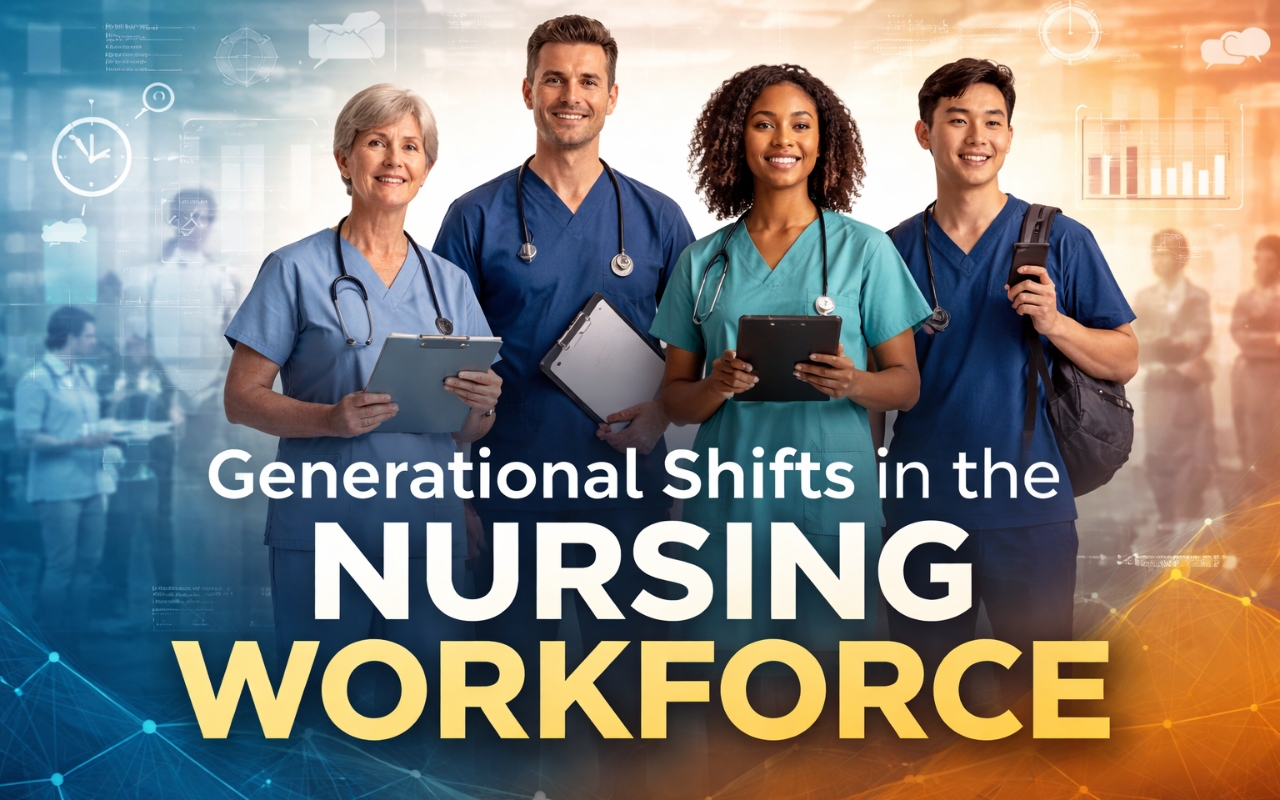
A new national report from Medical Solutions confirms what many nurse leaders are already seeing firsthand: generational differences are reshaping the clinician workforce and forcing hospitals to rethink how they recruit, staff, and retain nurses.
The report, Pulse Check: What We’re Hearing from Nurses, surveyed nearly 7,000 clinicians nationwide and paints a clear picture of a workforce in transition.
Baby Boomers are retiring at an accelerated pace, taking decades of bedside experience and leadership insight with them. Gen X and Millennials now make up the majority of clinicians and place greater emphasis on pay, workload balance, and flexibility. Meanwhile, Gen Z is entering the workforce with distinct expectations for structured learning, mentorship, and long-term career development.
For hospitals already managing burnout and turnover, these shifts are not abstract trends. They are operational realities that are reshaping staffing models and widening workforce gaps across the country.
The End of One-Size-Fits-All Workforce Strategy
According to Patti Artley, Chief Nursing & Clinical Officer at Medical Solutions, the most underestimated risk is assuming the workforce can be managed uniformly.
“One of the most important findings is that different generations have distinct preferences, expectations, and motivations,” Artley says. “Leaders cannot approach the workforce with a one-size-fits-all strategy. To effectively recruit, engage, and retain clinicians, organizations must recognize these differences and tailor their approaches accordingly.”
For healthcare leaders, that means workforce strategy must now be segmented and intentional.
The Experience Gap: What Retirement Really Means
The retirement of Baby Boomers represents more than vacancies. It threatens the loss of clinical judgment that is developed over decades.
“Critical thinking, deep understanding of disease processes, and the ability to recognize subtle signs and symptoms are developed through experience,” Artley explains. “These skills are built over years of working at the bedside with specific patient populations.”
Leadership expertise is equally vulnerable.
“Leaders not only follow policy but also think critically about outcomes and creatively develop solutions. Over time, they build strong coaching skills and learn how to invest in others. These capabilities come with experience and expertise, and they are at risk if succession planning is not intentional.”
Without deliberate succession planning, hospitals risk losing both bedside expertise and institutional leadership capacity.
From Overtime Dependence to Built-In Flexibility
As Gen X and Millennials become the majority, expectations around work have shifted.
“Baby Boomers tend to live to work, while newer generations are working to live,” Artley says. “They recognize that their lives do not revolve solely around their jobs.”
Historically, staffing gaps were often filled by seasoned clinicians picking up extra shifts. That model is no longer sustainable.
“In the past, when we had vacancies, callouts, or time off, we relied heavily on Baby Boomers to pick up extra shifts. That is no longer sustainable,” she says. “We now need to fill those gaps with contingent staff such as PRN, travel RNs, contract staff, or overtime. This is the right approach and likely reduces burnout while improving engagement.”
The takeaway is clear: flexibility must be designed into staffing models rather than treated as a backup plan.
“We must intentionally build flexibility into our staffing models and proactively plan how to support time off, ensuring both staffing needs are met, and team members feel supported.”
Updating Workforce Assumptions
Retention strategies are not new. What has changed is the level of precision required.
“Workforce strategic plans have included retention strategies for years,” Artley says. “However, in recent years, organizations have expanded both recruitment and retention strategies to better tailor approaches to different generations.”
Many systems now analyze workforce demographics by unit, increase bedside support, expand flexible options, and focus on enabling nurses to practice at the top of their license.
The shift reflects a broader recognition that generational alignment is now central to workforce stability.
Gen Z and the Redesign of Onboarding
As Gen Z clinicians enter practice, onboarding has evolved from orientation to long-term development.
“Most of the organizations we work with have had to change how they onboard, including how they orient their new nurses and get creative with their support to keep nurses in their system versus on a unit,” Artley says.
Health systems are strengthening mentorship, career pathways, succession planning, clinical ladder advancement, and other professional growth opportunities to support early-career nurses.
Onboarding is no longer transactional. It is strategic.
Sustainability, Not Entitlement
Generational expectations around boundaries are sometimes dismissed as entitlement. Artley urges nuance.
“Generalizations are always tricky, and I would say you can find both perspectives within organizations, just as not all Baby Boomers are alike.”
She emphasizes that balance supports safe practice.
“Nursing is physically, mentally, and emotionally demanding, yet incredibly rewarding. Establishing boundaries supports sustainability and safe practice, which ultimately benefits both clinicians and patients.”
In this context, flexibility is less about preference and more about workforce longevity.
Multigenerational Teams as a Competitive Advantage
Flexibility scores were high across all generations, suggesting a shared shift in values.
“This may indicate a growing recognition of the value of balance and its role in helping clinicians remain at the bedside longer,” Artley says.
Millennials and Gen Z bring strong technology fluency and a desire to learn. Baby Boomers contribute deep clinical expertise and judgment.
“When teams value and leverage each other’s strengths, they can build highly effective, collaborative units.”
When generational strengths are intentionally integrated, care teams become more resilient.
Where Hospitals Are Most Vulnerable
The greatest risk lies in inaction.
“An aging workforce may choose to retire sooner if they do not feel supported,” Artley says. “At the same time, newer generations may pursue career advancement away from the bedside if their needs are not met. This combination could create workforce gaps that are difficult to close.”
Without adaptation, hospitals face widening experience gaps, persistent turnover, and mounting strain on care delivery.
What the Workforce Could Become
If health systems respond strategically, Artley sees a more sustainable future.
“We could have high-functioning, diverse teams that value each other with a shared goal of caring for their patients to the best of their capability, and nurses are well supported.”
The generational shift is structural, not temporary. For healthcare leaders, the imperative is clear: align workforce strategy with evolving expectations or risk falling further behind.
